Solar system · Saturn
Where is Saturn right now?
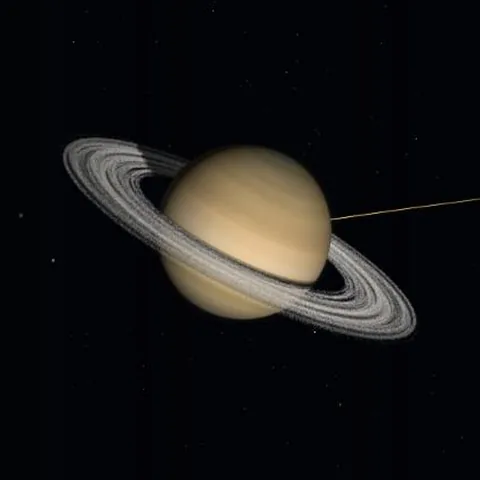
Saturn takes 29 and a half years to go round the Sun, so it spends two or three years in each constellation of the zodiac. It is the planet everyone knows by its rings, and Exo-View puts it where it is at this moment, tipped as it is in the sky, with its rings made of thousands of separate particles.
- Orbit
- 29.5 years
- Distance from the Sun
- 9.5 AU on average, about 1.43 billion km
- Width
- About 116,000 km: nine Earths side by side, without the rings
- Density
- 0.69 g/cm³: less than water, so it would float in a big enough ocean
- Day
- A little over 10½ hours
- Tilt
- 26.7°, so we see its rings from above, then edge-on, then from below over about 15 years
- Rings
- About 280,000 km across and, for most of that, only about ten metres thick
What the rings are
Saturn's rings are not solid. They are made of countless pieces of mostly water ice, from grains of sand to blocks the size of a house, each in its own orbit round the planet. They are wide enough to hold about twenty Earths side by side, yet thin enough that when we see them edge-on, as we did in 2025, they almost vanish. Because Saturn is tilted, we see them from above, edge-on, then from below over about 15 years.
Where the rings came from is still argued: they may be a moon torn apart, or the remains of a comet, and some measurements suggest they are young, perhaps only a hundred million years old.
Where it is, and seeing it
Earth passes Saturn about every 378 days, an opposition, when it is nearest and brightest. To the naked eye it is a steady, yellowish point about as bright as the brightest stars; a small telescope, from about 30 times magnification, shows the rings, and Galileo, whose first telescope could not separate them, drew them as two ears in 1610.
Titan and the other moons
Saturn has well over a hundred moons. Titan, the largest, is bigger than Mercury and the only moon with a thick atmosphere, and it has rivers and lakes of liquid methane. Exo-View places Titan where it is now. The Cassini spacecraft studied the system from orbit from 2004 to 2017.
In Exo-View
The key below flies to Saturn and its rings. Fly close and the rings turn from a flat disc into a shower of separate particles, and you can stand among them.
Fly to SaturnSee every planetMore from the sky
- Space simulations in 3D
- The total solar eclipse of 2 August 2027
- T Coronae Borealis, the Blaze Star
- When Betelgeuse explodes
- Meteor showers, through the year
- Falling into a black hole
- Where is the International Space Station right now?
- Every working satellite in orbit
- Where are the planets right now?
- A 3D map of the Milky Way
- Where is Mars right now?
- Where is Jupiter right now?
- The Moon in 3D: where it is and how it moves
- Proxima Centauri: the nearest star to the Sun
- TRAPPIST-1: seven Earth-sized planets round one small star
- Tau Ceti: the nearest single star like the Sun
- Barnard's Star: the fastest-moving star in the sky
- The Orion Nebula: where stars are born
- The Crab Nebula: what is left of a star that exploded in 1054
- The Eagle Nebula and the Pillars of Creation
- The Helix Nebula: what will happen to the Sun
- Sagittarius A*: the black hole at the centre of the Milky Way
- Cygnus X-1: the first black hole anyone was sure of
- Gaia BH1: the nearest known black hole
- Sirius: the brightest star in the night sky
- Where is the James Webb Space Telescope right now?
- Where is the Hubble Space Telescope right now?
- Parker Solar Probe: the closest anyone has been to the Sun
- Where is Venus right now?
- Where is Mercury right now?
- Where is Uranus right now?
- Where is Neptune right now?
- Europa: a moon with an ocean under its ice
- Titan: the moon with lakes and weather
- Arcturus: the brightest star of the northern sky
- Teegarden's Star: a tiny star with Earth-mass planets
- The Horsehead Nebula: a cloud shaped like a horse
- The Carina Nebula: a star nursery with a star about to explode
- Gaia BH3: the heaviest black hole of its kind in the Milky Way
- Where is the Juno spacecraft right now?