Moons · Jupiter
Europa: a moon with an ocean under its ice
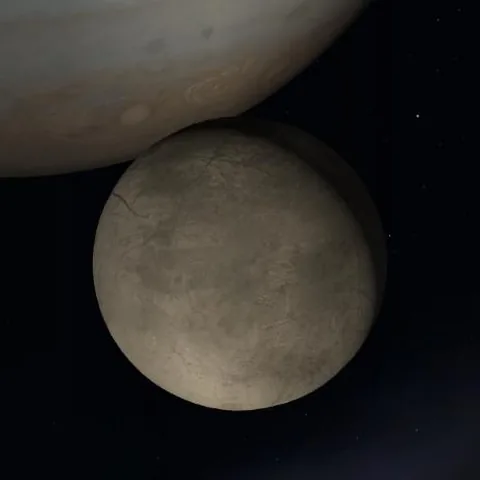
Europa is a moon of Jupiter, a little smaller than our Moon, with a smooth, cracked shell of ice and, under it, an ocean of salty liquid water that holds more water than all the Earth's oceans. It is one of the best places in the solar system to look for life. Exo-View puts it where it is now, beside Jupiter.
- Orbit
- 3.55 days round Jupiter, at 671,100 km
- Width
- 3,122 km, a little smaller than the Moon
- Shell
- Ice some tens of km thick
- Ocean
- Probably 60 to 150 km deep, with about twice the water of all Earth's oceans
- Surface temperature
- About −160 °C
- Found
- In January 1610 by Galileo
How we know about the ocean
The Galileo spacecraft, which orbited Jupiter from 1995 to 2003, found that Europa's magnetic field changes as Jupiter's sweeps past, as it would if a layer of salty water were beneath the ice. Its surface has few craters, so it is young and has been resurfaced, and it is covered in long cracks and ridges. Hubble has seen what may be plumes of water vapour rising from near the south pole.
Where the heat comes from
Europa is kneaded by tides. Jupiter's pull and that of its neighbours Io and Ganymede squeeze it a little differently with each orbit, and the flexing warms its inside, enough to keep water liquid so far from the Sun. On the Earth, life lives round vents on the seafloor where hot water meets rock; Europa might have the same, though no one knows.
Missions
NASA's Europa Clipper was launched in October 2024 and is due at Jupiter in 2030, to fly past Europa nearly fifty times and study the shell and ocean from above. ESA's JUICE is also on its way, and will fly by it before it settles into orbit round Ganymede. Neither will land.
In Exo-View
The button below flies from the Sun to Europa, with Jupiter looming behind it. Europa and the other three big moons are placed where they are today, so you can see which side of the planet it is on. Europa Clipper is on the Spacecraft layer.
Fly to EuropaSee JupiterMore from the sky
- Space simulations in 3D
- The total solar eclipse of 2 August 2027
- T Coronae Borealis, the Blaze Star
- When Betelgeuse explodes
- Meteor showers, through the year
- Falling into a black hole
- Where is the International Space Station right now?
- Every working satellite in orbit
- Where are the planets right now?
- A 3D map of the Milky Way
- Where is Mars right now?
- Where is Jupiter right now?
- Where is Saturn right now?
- The Moon in 3D: where it is and how it moves
- Proxima Centauri: the nearest star to the Sun
- TRAPPIST-1: seven Earth-sized planets round one small star
- Tau Ceti: the nearest single star like the Sun
- Barnard's Star: the fastest-moving star in the sky
- The Orion Nebula: where stars are born
- The Crab Nebula: what is left of a star that exploded in 1054
- The Eagle Nebula and the Pillars of Creation
- The Helix Nebula: what will happen to the Sun
- Sagittarius A*: the black hole at the centre of the Milky Way
- Cygnus X-1: the first black hole anyone was sure of
- Gaia BH1: the nearest known black hole
- Sirius: the brightest star in the night sky
- Where is the James Webb Space Telescope right now?
- Where is the Hubble Space Telescope right now?
- Parker Solar Probe: the closest anyone has been to the Sun
- Where is Venus right now?
- Where is Mercury right now?
- Where is Uranus right now?
- Where is Neptune right now?
- Titan: the moon with lakes and weather
- Arcturus: the brightest star of the northern sky
- Teegarden's Star: a tiny star with Earth-mass planets
- The Horsehead Nebula: a cloud shaped like a horse
- The Carina Nebula: a star nursery with a star about to explode
- Gaia BH3: the heaviest black hole of its kind in the Milky Way
- Where is the Juno spacecraft right now?