Nebulae · dark
The Horsehead Nebula: a cloud shaped like a horse
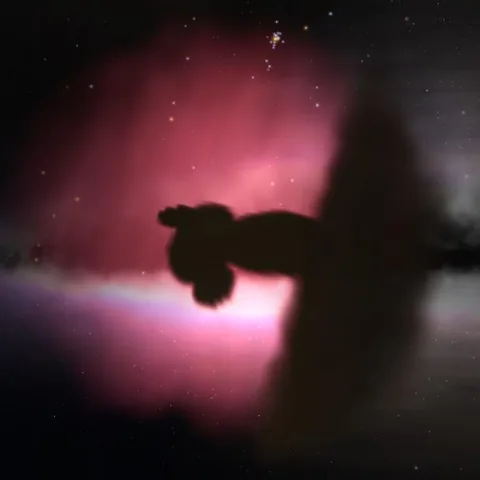
The Horsehead Nebula is a cold, dark cloud of dust and gas in the constellation Orion, 1,375 light-years away, shaped like the head of a chess knight. It shows only because it lies in front of a bright glow of hydrogen behind it. Exo-View lets you fly to it and see the pink glow with the dark horse against it.
- Distance
- About 1,375 light-years
- Size
- About 3.5 light-years from the ears to the throat
- Kind
- Dark nebula, a cloud of dust that blocks light
- Catalogue number
- Barnard 33; the glow behind it is IC 434
- Found
- In 1888 by Williamina Fleming, on a photographic plate
- Seen in
- The constellation Orion, just below Alnitak, the star at one end of the Belt
A shadow in the shape of a horse
The Horsehead is a knot of cold gas and dust that sticks out from a larger cloud, and it is opaque: it blocks the light behind it. The pink glow it stands against is hydrogen lit by a hot star nearby, Sigma Orionis. Williamina Fleming spotted the shape in 1888 on a photographic plate at Harvard, and it has been one of the most photographed objects in the sky since.
Seeing it
It is very hard to see by eye. It needs a dark sky, a fairly large telescope and a filter that passes only the glow of hydrogen, and even then it is faint. Long photographs show it well. It is near Alnitak, the star at one end of Orion's Belt, next to the Flame Nebula, in the same great cloud as the Orion Nebula.
Not for ever
The horse is slowly being worn away by the radiation of nearby stars, and may last only a few million more years before it disperses. At the scale of the stars, that is a short life.
In Exo-View
The button below flies from the Sun to the Horsehead. Its shape is made from photographs, so it is an artist's impression, and the plate says so.
Fly to the Horsehead NebulaSee the Orion NebulaMore from the sky
- Space simulations in 3D
- The total solar eclipse of 2 August 2027
- T Coronae Borealis, the Blaze Star
- When Betelgeuse explodes
- Meteor showers, through the year
- Falling into a black hole
- Where is the International Space Station right now?
- Every working satellite in orbit
- Where are the planets right now?
- A 3D map of the Milky Way
- Where is Mars right now?
- Where is Jupiter right now?
- Where is Saturn right now?
- The Moon in 3D: where it is and how it moves
- Proxima Centauri: the nearest star to the Sun
- TRAPPIST-1: seven Earth-sized planets round one small star
- Tau Ceti: the nearest single star like the Sun
- Barnard's Star: the fastest-moving star in the sky
- The Orion Nebula: where stars are born
- The Crab Nebula: what is left of a star that exploded in 1054
- The Eagle Nebula and the Pillars of Creation
- The Helix Nebula: what will happen to the Sun
- Sagittarius A*: the black hole at the centre of the Milky Way
- Cygnus X-1: the first black hole anyone was sure of
- Gaia BH1: the nearest known black hole
- Sirius: the brightest star in the night sky
- Where is the James Webb Space Telescope right now?
- Where is the Hubble Space Telescope right now?
- Parker Solar Probe: the closest anyone has been to the Sun
- Where is Venus right now?
- Where is Mercury right now?
- Where is Uranus right now?
- Where is Neptune right now?
- Europa: a moon with an ocean under its ice
- Titan: the moon with lakes and weather
- Arcturus: the brightest star of the northern sky
- Teegarden's Star: a tiny star with Earth-mass planets
- The Carina Nebula: a star nursery with a star about to explode
- Gaia BH3: the heaviest black hole of its kind in the Milky Way
- Where is the Juno spacecraft right now?