Stars · a giant
Arcturus: the brightest star of the northern sky
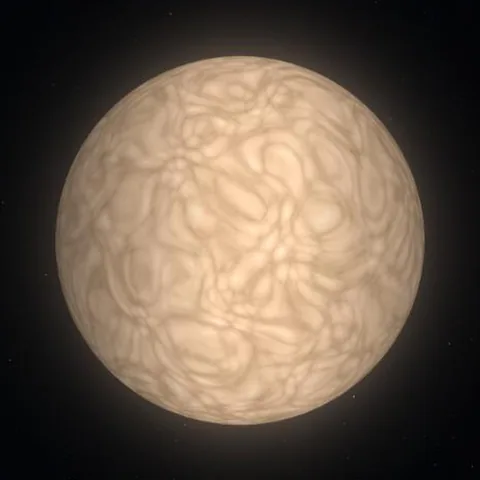
Arcturus is the fourth brightest star in the night sky and the brightest north of the celestial equator, 36.7 light-years away in the constellation Boötes. It is an orange giant: a star like the Sun some seven billion years on, whose outer layers have swollen to 25 times the Sun's width. The Sun will be one. Exo-View flies you to it.
- Distance
- 36.7 light-years
- Kind
- Orange giant, spectral type K1.5
- Size
- 25 times the Sun's width
- Surface temperature
- About 4,300 K, against the Sun's 5,800 K
- Light
- About 170 times the Sun's
- Spin
- Once in about two years
- Seen in
- The constellation Boötes, the Herdsman
Finding it
Follow the curve of the handle of the Plough, or Big Dipper, away from the pan: 'arc to Arcturus', the old saying goes, then 'speed on to Spica', the next bright star. Arcturus is a warm orange, clearly different from the white of most bright stars, and it is high in the sky on spring evenings in the north.
A star at the end of its fuel
Arcturus has used up the hydrogen at its core. Its centre has shrunk and heated while its outer layers have swollen and cooled, which is why it is both huge and orange. It is about as massive as the Sun, but it gives out 170 times as much light. In about five billion years the Sun will go the same way, swelling to something like Arcturus's size, and swallowing Mercury and Venus.
A fast star from the Galaxy's older population
Arcturus is moving fast, at about 120 km/s relative to the Sun, in a different direction from most nearby stars: it belongs to an older population of stars in the Milky Way's thick disc, with fewer heavy elements than the Sun. When the Century of Progress world's fair opened in Chicago in 1933, the light of Arcturus, then thought to have left the star at about the time of the previous Chicago fair, in 1893, was used to switch on the lights.
In Exo-View
The button below flies from the Sun to Arcturus. Its surface is drawn as a mottled pattern of huge convection cells, an illustration of what the physics says, and the plate says so.
Fly to ArcturusSee the Milky WayMore from the sky
- Space simulations in 3D
- The total solar eclipse of 2 August 2027
- T Coronae Borealis, the Blaze Star
- When Betelgeuse explodes
- Meteor showers, through the year
- Falling into a black hole
- Where is the International Space Station right now?
- Every working satellite in orbit
- Where are the planets right now?
- A 3D map of the Milky Way
- Where is Mars right now?
- Where is Jupiter right now?
- Where is Saturn right now?
- The Moon in 3D: where it is and how it moves
- Proxima Centauri: the nearest star to the Sun
- TRAPPIST-1: seven Earth-sized planets round one small star
- Tau Ceti: the nearest single star like the Sun
- Barnard's Star: the fastest-moving star in the sky
- The Orion Nebula: where stars are born
- The Crab Nebula: what is left of a star that exploded in 1054
- The Eagle Nebula and the Pillars of Creation
- The Helix Nebula: what will happen to the Sun
- Sagittarius A*: the black hole at the centre of the Milky Way
- Cygnus X-1: the first black hole anyone was sure of
- Gaia BH1: the nearest known black hole
- Sirius: the brightest star in the night sky
- Where is the James Webb Space Telescope right now?
- Where is the Hubble Space Telescope right now?
- Parker Solar Probe: the closest anyone has been to the Sun
- Where is Venus right now?
- Where is Mercury right now?
- Where is Uranus right now?
- Where is Neptune right now?
- Europa: a moon with an ocean under its ice
- Titan: the moon with lakes and weather
- Teegarden's Star: a tiny star with Earth-mass planets
- The Horsehead Nebula: a cloud shaped like a horse
- The Carina Nebula: a star nursery with a star about to explode
- Gaia BH3: the heaviest black hole of its kind in the Milky Way
- Where is the Juno spacecraft right now?