Stars · exoplanets
TRAPPIST-1: seven Earth-sized planets round one small star
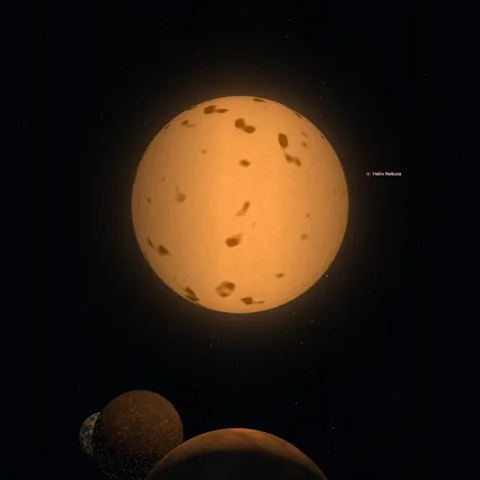
TRAPPIST-1 is a star barely larger than Jupiter, 40.7 light-years from the Sun, and seven planets of about Earth's size go round it, every one of them closer to it than Mercury is to the Sun. It is one of the best places we know to ask whether a small rocky planet can keep an atmosphere, and in Exo-View you can fly there and see all seven.
- Distance
- 40.7 light-years, in the constellation Aquarius
- Kind
- Ultra-cool red dwarf, spectral type M8
- Size
- 0.12 times the Sun's width, just over Jupiter's
- Surface temperature
- About 2,570 K
- Planets
- Seven, b to h; e, f and g lie in the habitable zone
| Planet | Width (Earth = 1) | Orbit (days) | From the star (AU) |
|---|---|---|---|
| b | 1.12 | 1.5 | 0.0115 |
| c | 1.10 | 2.4 | 0.0158 |
| d | 0.79 | 4.0 | 0.0223 |
| e | 0.92 | 6.1 | 0.0293 |
| f | 1.05 | 9.2 | 0.0385 |
| g | 1.13 | 12.4 | 0.0469 |
| h | 0.76 | 18.8 | 0.0619 |
The sizes are measured as each planet crosses its star's face; the distances are from the periods. Mercury is 0.39 AU from the Sun.
How they were found
The star is named for the TRAPPIST telescope in Chile, which in 2016 saw it dim three times, as three planets crossed in front of it. A year later, with the Spitzer space telescope, the count rose to seven. Each time a planet passes in front of the star, its dip in the light tells us the planet's size.
A crowded sky
The whole system would fit inside Mercury's orbit. The planets are so close to each other that, from the surface of one, the others would hang in the sky larger than our Moon does. Their orbits are locked in a chain, each period close to a simple ratio of the next, which shows they formed further out and moved in together. Each is probably locked with one face to the star, a permanent day side and a permanent night side.
Could any of them have air?
A red dwarf is a rough neighbour: it flares often and floods its planets with ultraviolet and X-rays that can strip away an atmosphere. The James Webb Space Telescope has looked at the two innermost planets, b and c, and found no thick atmosphere on either. Astronomers are now watching the cooler planets, in the habitable zone, where air is more likely to survive. Whether any of them has air or water is not yet known.
In Exo-View
The key below flies from the Sun to TRAPPIST-1. Its seven planets are drawn in their real orbits, with sizes and periods from the table; their surfaces are an illustration made from those figures, since no one has a picture of a planet so far away, and the plates say so.
Fly to TRAPPIST-1See the Milky WayMore from the sky
- Space simulations in 3D
- The total solar eclipse of 2 August 2027
- T Coronae Borealis, the Blaze Star
- When Betelgeuse explodes
- Meteor showers, through the year
- Falling into a black hole
- Where is the International Space Station right now?
- Every working satellite in orbit
- Where are the planets right now?
- A 3D map of the Milky Way
- Where is Mars right now?
- Where is Jupiter right now?
- Where is Saturn right now?
- The Moon in 3D: where it is and how it moves
- Proxima Centauri: the nearest star to the Sun
- Tau Ceti: the nearest single star like the Sun
- Barnard's Star: the fastest-moving star in the sky
- The Orion Nebula: where stars are born
- The Crab Nebula: what is left of a star that exploded in 1054
- The Eagle Nebula and the Pillars of Creation
- The Helix Nebula: what will happen to the Sun
- Sagittarius A*: the black hole at the centre of the Milky Way
- Cygnus X-1: the first black hole anyone was sure of
- Gaia BH1: the nearest known black hole
- Sirius: the brightest star in the night sky
- Where is the James Webb Space Telescope right now?
- Where is the Hubble Space Telescope right now?
- Parker Solar Probe: the closest anyone has been to the Sun
- Where is Venus right now?
- Where is Mercury right now?
- Where is Uranus right now?
- Where is Neptune right now?
- Europa: a moon with an ocean under its ice
- Titan: the moon with lakes and weather
- Arcturus: the brightest star of the northern sky
- Teegarden's Star: a tiny star with Earth-mass planets
- The Horsehead Nebula: a cloud shaped like a horse
- The Carina Nebula: a star nursery with a star about to explode
- Gaia BH3: the heaviest black hole of its kind in the Milky Way
- Where is the Juno spacecraft right now?