Space telescopes · Hubble
Where is the Hubble Space Telescope right now?
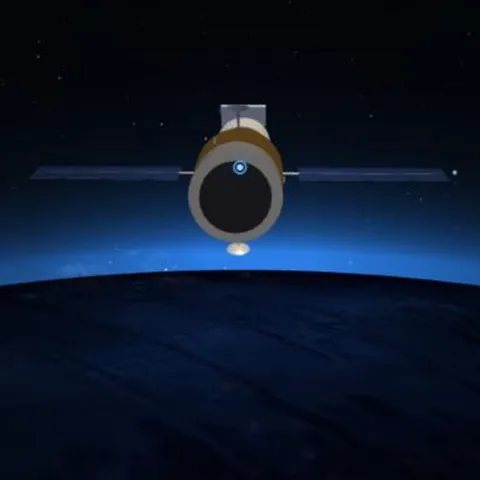
The Hubble Space Telescope has been going round the Earth since April 1990, about 500 km up, once every 95 minutes, at about 7.6 km a second. It is the best-known telescope in history, and it is still working. Exo-View shows where it is over the Earth at this moment and lets you fly beside it.
- Height
- About 470 km, slowly sinking
- Orbit
- About 95 minutes: 15 times a day
- Speed
- About 7.6 km/s
- Tilt of its orbit
- 28.5° to the equator
- Mirror
- 2.4 m across
- Mass
- About 11,000 kg, the weight of two elephants
- Launched
- 24 April 1990, on the Space Shuttle Discovery
The telescope that was fixed
Hubble's mirror was ground to the wrong shape and its first pictures were blurred. In 1993 astronauts fitted it with corrective optics, and it became the telescope people remember. Four more shuttle missions, the last in 2009, replaced its cameras and gyroscopes and kept it going. No one can service it now, and it works on a single gyroscope after the others failed, which slows it a little but not its pictures.
What it found
Hubble measured how fast the universe is expanding, helped to show that the expansion is speeding up, and took the Deep Field pictures of thousands of galaxies in a patch of sky the size of a grain of sand held at arm's length. It has made over a million observations, and is named for Edwin Hubble, who found that the galaxies are moving apart.
How long it has
Hubble is in low orbit, where the thin upper air drags on it and slowly pulls it down. It is expected to stay up into the 2030s. Its place here is worked out in your browser from its published orbital elements, good to a few kilometres for about two weeks after they are taken, and is approximate.
In Exo-View
The key below switches the Spacecraft layer on and flies to Hubble over the Earth. Its model is drawn larger than life so you can see it, with the Earth beneath. Its plate gives its height, speed and launch date.
Fly to HubbleVisit the Webb telescopeMore from the sky
- Space simulations in 3D
- The total solar eclipse of 2 August 2027
- T Coronae Borealis, the Blaze Star
- When Betelgeuse explodes
- Meteor showers, through the year
- Falling into a black hole
- Where is the International Space Station right now?
- Every working satellite in orbit
- Where are the planets right now?
- A 3D map of the Milky Way
- Where is Mars right now?
- Where is Jupiter right now?
- Where is Saturn right now?
- The Moon in 3D: where it is and how it moves
- Proxima Centauri: the nearest star to the Sun
- TRAPPIST-1: seven Earth-sized planets round one small star
- Tau Ceti: the nearest single star like the Sun
- Barnard's Star: the fastest-moving star in the sky
- The Orion Nebula: where stars are born
- The Crab Nebula: what is left of a star that exploded in 1054
- The Eagle Nebula and the Pillars of Creation
- The Helix Nebula: what will happen to the Sun
- Sagittarius A*: the black hole at the centre of the Milky Way
- Cygnus X-1: the first black hole anyone was sure of
- Gaia BH1: the nearest known black hole
- Sirius: the brightest star in the night sky
- Where is the James Webb Space Telescope right now?
- Parker Solar Probe: the closest anyone has been to the Sun
- Where is Venus right now?
- Where is Mercury right now?
- Where is Uranus right now?
- Where is Neptune right now?
- Europa: a moon with an ocean under its ice
- Titan: the moon with lakes and weather
- Arcturus: the brightest star of the northern sky
- Teegarden's Star: a tiny star with Earth-mass planets
- The Horsehead Nebula: a cloud shaped like a horse
- The Carina Nebula: a star nursery with a star about to explode
- Gaia BH3: the heaviest black hole of its kind in the Milky Way
- Where is the Juno spacecraft right now?