Solar system · Mars
Where is Mars right now?
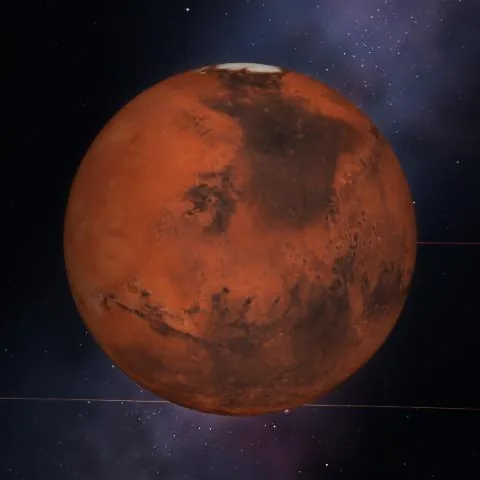
Mars goes round the Sun once in 687 days, Earth once in 365, so the two planets keep passing and drifting apart: the distance between them swings from about 55 million km to about 400 million. Exo-View puts Mars where it is at this moment, worked out from its orbit, and lets you fly in to it.
- Orbit
- 687 days: a Martian year is 1.9 Earth years
- Distance from the Sun
- 1.52 AU on average, from 1.38 at its nearest to 1.67 at its farthest
- Distance from Earth
- From about 55 million km at the nearest to about 400 million km with the Sun between us
- Day
- 24 hours 37 minutes
- Width
- 6,779 km, a little over half the Earth's
- Tilt
- 25.2°, so it has seasons like ours, each nearly twice as long
- Moons
- Two small ones, Phobos and Deimos
Why its place keeps changing
Earth is the faster runner. About every 26 months it catches Mars and passes it, and at that moment, called an opposition, Mars is at its nearest, at its brightest, and in the sky all night. Over the next year the gap opens again until Mars is on the far side of the Sun, lost in its glare, before Earth comes round to catch it once more.
Mars's orbit is more oval than the Earth's, so oppositions are not all alike. When one falls with Mars near its closest point to the Sun the two planets come within about 55 million km; when it falls with Mars at its farthest they stay about 100 million km apart.
Seeing it
Mars is easy to find: a steady, orange-red point that does not twinkle, the colour of the iron-rich dust that covers it. Near opposition it rivals Jupiter and outshines every star. A small telescope shows its white polar caps and dark patches in the best few weeks of each opposition.
Radio and light take between about 3 and 22 minutes to cross the gap, depending on where the two planets are, which is why the rovers on Mars drive themselves between instructions.
What is on it
Mars has the tallest volcano in the solar system, Olympus Mons, about 22 km high, and a canyon system, Valles Marineris, some 4,000 km long, about the width of the United States. Its air is thin, mostly carbon dioxide, with less than 1% of the pressure at Earth's surface; its poles are capped with water ice and frozen carbon dioxide; and its dry river beds and lake basins say it once had running water. Gravity is 38% of Earth's. The rovers Curiosity and Perseverance have been exploring it since 2012 and 2021.
In Exo-View
The key below flies from the Sun out to Mars, wrapped in its own maps. Open its plate for its size, day, tilt and year, and fly on to the other planets from there. Run the clock forward to watch Earth catch up with it.
Fly to MarsSee every planetMore from the sky
- Space simulations in 3D
- The total solar eclipse of 2 August 2027
- T Coronae Borealis, the Blaze Star
- When Betelgeuse explodes
- Meteor showers, through the year
- Falling into a black hole
- Where is the International Space Station right now?
- Every working satellite in orbit
- Where are the planets right now?
- A 3D map of the Milky Way
- Where is Jupiter right now?
- Where is Saturn right now?
- The Moon in 3D: where it is and how it moves
- Proxima Centauri: the nearest star to the Sun
- TRAPPIST-1: seven Earth-sized planets round one small star
- Tau Ceti: the nearest single star like the Sun
- Barnard's Star: the fastest-moving star in the sky
- The Orion Nebula: where stars are born
- The Crab Nebula: what is left of a star that exploded in 1054
- The Eagle Nebula and the Pillars of Creation
- The Helix Nebula: what will happen to the Sun
- Sagittarius A*: the black hole at the centre of the Milky Way
- Cygnus X-1: the first black hole anyone was sure of
- Gaia BH1: the nearest known black hole
- Sirius: the brightest star in the night sky
- Where is the James Webb Space Telescope right now?
- Where is the Hubble Space Telescope right now?
- Parker Solar Probe: the closest anyone has been to the Sun
- Where is Venus right now?
- Where is Mercury right now?
- Where is Uranus right now?
- Where is Neptune right now?
- Europa: a moon with an ocean under its ice
- Titan: the moon with lakes and weather
- Arcturus: the brightest star of the northern sky
- Teegarden's Star: a tiny star with Earth-mass planets
- The Horsehead Nebula: a cloud shaped like a horse
- The Carina Nebula: a star nursery with a star about to explode
- Gaia BH3: the heaviest black hole of its kind in the Milky Way
- Where is the Juno spacecraft right now?