Solar system · Jupiter
Where is Jupiter right now?
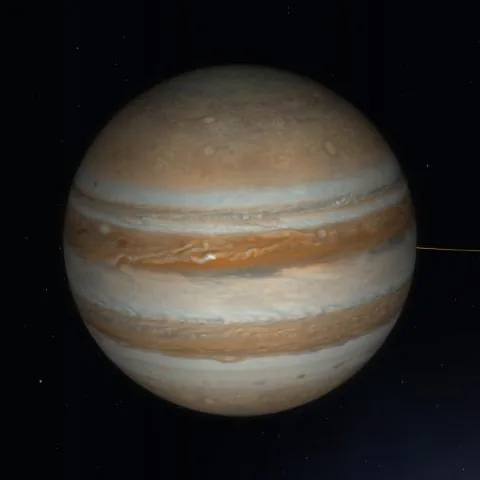
Jupiter is the largest planet by far, more than twice as massive as all the others put together, and it takes nearly 12 years to go once round the Sun, so it spends about a year in each constellation of the zodiac. Exo-View puts it where it is at this moment, with its four big moons beside it.
- Orbit
- 11.86 years
- Distance from the Sun
- 5.2 AU on average, about 778 million km
- Width
- About 140,000 km: eleven Earths side by side
- Mass
- 318 times the Earth's, about 2.5 times all the other planets together
- Day
- 9 hours 55 minutes, the shortest of any planet
- Moons
- More than ninety known; the four big ones are Io, Europa, Ganymede and Callisto
- Brightness
- After the Moon and Venus, usually the brightest thing in the night sky
Why it moves so slowly
Jupiter's year is nearly 12 Earth years, so it creeps round the sky. Earth overtakes it about every 13 months, and at that moment, its opposition, Jupiter is nearest, brightest and up all night. A few months either side it is still easy to see; about half a year after opposition it is behind the Sun, and for a few weeks it cannot be seen at all.
The four big moons
Galileo turned a telescope on Jupiter in January 1610 and saw four small stars in a line beside it that changed places from night to night. They were moons going round it, the first seen to circle a planet other than the Earth. Ganymede is the biggest moon in the solar system, larger than Mercury; Io is the most volcanic body known; Europa hides an ocean under its ice; Callisto is the most heavily cratered. Good binoculars, held steady, show all four.
What it is
Jupiter has no surface to stand on: it is mostly hydrogen and helium, thickening with depth to a liquid and perhaps a small core. Its bands are winds blowing in opposite directions at hundreds of km/h, and the Great Red Spot, a storm wider than the Earth, has been watched for more than 150 years. It has faint rings and a magnetic field the strongest of any planet.
In Exo-View
The key below flies out to Jupiter, mapped from its photographs. Its four big moons are placed where they are now, so you can see which side of the planet Io is on today, and open each one's plate from there.
Fly to JupiterSee every planetMore from the sky
- Space simulations in 3D
- The total solar eclipse of 2 August 2027
- T Coronae Borealis, the Blaze Star
- When Betelgeuse explodes
- Meteor showers, through the year
- Falling into a black hole
- Where is the International Space Station right now?
- Every working satellite in orbit
- Where are the planets right now?
- A 3D map of the Milky Way
- Where is Mars right now?
- Where is Saturn right now?
- The Moon in 3D: where it is and how it moves
- Proxima Centauri: the nearest star to the Sun
- TRAPPIST-1: seven Earth-sized planets round one small star
- Tau Ceti: the nearest single star like the Sun
- Barnard's Star: the fastest-moving star in the sky
- The Orion Nebula: where stars are born
- The Crab Nebula: what is left of a star that exploded in 1054
- The Eagle Nebula and the Pillars of Creation
- The Helix Nebula: what will happen to the Sun
- Sagittarius A*: the black hole at the centre of the Milky Way
- Cygnus X-1: the first black hole anyone was sure of
- Gaia BH1: the nearest known black hole
- Sirius: the brightest star in the night sky
- Where is the James Webb Space Telescope right now?
- Where is the Hubble Space Telescope right now?
- Parker Solar Probe: the closest anyone has been to the Sun
- Where is Venus right now?
- Where is Mercury right now?
- Where is Uranus right now?
- Where is Neptune right now?
- Europa: a moon with an ocean under its ice
- Titan: the moon with lakes and weather
- Arcturus: the brightest star of the northern sky
- Teegarden's Star: a tiny star with Earth-mass planets
- The Horsehead Nebula: a cloud shaped like a horse
- The Carina Nebula: a star nursery with a star about to explode
- Gaia BH3: the heaviest black hole of its kind in the Milky Way
- Where is the Juno spacecraft right now?