Black holes · the galactic centre
Sagittarius A*: the black hole at the centre of the Milky Way
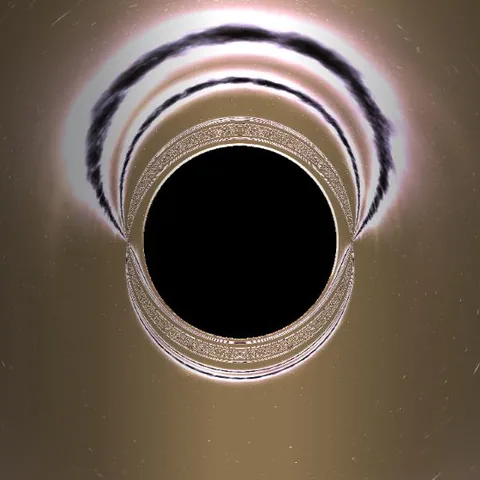
At the centre of our galaxy, 26,670 light-years from the Sun in the constellation Sagittarius, sits a black hole of about four million Suns. Nobody has seen it directly; we know it from the stars that race round it, and since 2022 from a picture of its shadow. In Exo-View you can fly there from the Sun.
- Distance
- 26,670 light-years
- Mass
- About 4.15 million Suns
- Horizon
- About 12 million km in radius, a size that would fit inside Mercury's orbit
- Kind
- Supermassive black hole, quiet: it gives off only a few hundred Suns' worth of light
- Nearest star
- S2, 16 years round, 120 AU from the hole at its nearest, in May 2018
- Pictured
- By the Event Horizon Telescope, announced in May 2022
How we know it is there
The centre of the galaxy is hidden from us by dust, but infrared telescopes see through it. For almost thirty years two teams, led by Reinhard Genzel and Andrea Ghez, tracked the stars at the very centre, and found them whirling round an invisible point at thousands of km a second. The star S2 goes round it once in 16 years on a long oval; in 2018 it swept past at about 7,650 km/s, 2.5% of the speed of light, and its light was stretched by the hole's gravity just as Einstein's theory says it should. Only a black hole of four million Suns, squeezed into a space smaller than S2's orbit, fits. The work won the 2020 Nobel Prize in Physics.
The picture of its shadow
In May 2022 the Event Horizon Telescope, a set of radio dishes across the Earth working as one, released an image of Sagittarius A*: a dark shadow ringed by a bright circle of hot gas, which is light bent round the hole by its gravity. The ring is about 52 millionths of an arcsecond across, like seeing a doughnut on the Moon from the Earth. The hole is quiet, feeding on little, which is why it is so faint for its mass.
In Exo-View
The key below flies from the Sun to the galactic centre and draws the hole as that picture shows it, a shadow edged by its ring with the sky bent round it. S2's orbit is drawn closer in than it is, on its true shape and timing, and the plate says so. The star is next at its nearest in 2034.
Fly to Sagittarius A*See the Milky WayMore from the sky
- Space simulations in 3D
- The total solar eclipse of 2 August 2027
- T Coronae Borealis, the Blaze Star
- When Betelgeuse explodes
- Meteor showers, through the year
- Falling into a black hole
- Where is the International Space Station right now?
- Every working satellite in orbit
- Where are the planets right now?
- A 3D map of the Milky Way
- Where is Mars right now?
- Where is Jupiter right now?
- Where is Saturn right now?
- The Moon in 3D: where it is and how it moves
- Proxima Centauri: the nearest star to the Sun
- TRAPPIST-1: seven Earth-sized planets round one small star
- Tau Ceti: the nearest single star like the Sun
- Barnard's Star: the fastest-moving star in the sky
- The Orion Nebula: where stars are born
- The Crab Nebula: what is left of a star that exploded in 1054
- The Eagle Nebula and the Pillars of Creation
- The Helix Nebula: what will happen to the Sun
- Cygnus X-1: the first black hole anyone was sure of
- Gaia BH1: the nearest known black hole
- Sirius: the brightest star in the night sky
- Where is the James Webb Space Telescope right now?
- Where is the Hubble Space Telescope right now?
- Parker Solar Probe: the closest anyone has been to the Sun
- Where is Venus right now?
- Where is Mercury right now?
- Where is Uranus right now?
- Where is Neptune right now?
- Europa: a moon with an ocean under its ice
- Titan: the moon with lakes and weather
- Arcturus: the brightest star of the northern sky
- Teegarden's Star: a tiny star with Earth-mass planets
- The Horsehead Nebula: a cloud shaped like a horse
- The Carina Nebula: a star nursery with a star about to explode
- Gaia BH3: the heaviest black hole of its kind in the Milky Way
- Where is the Juno spacecraft right now?