Nebulae · supernova remnant
The Crab Nebula: what is left of a star that exploded in 1054
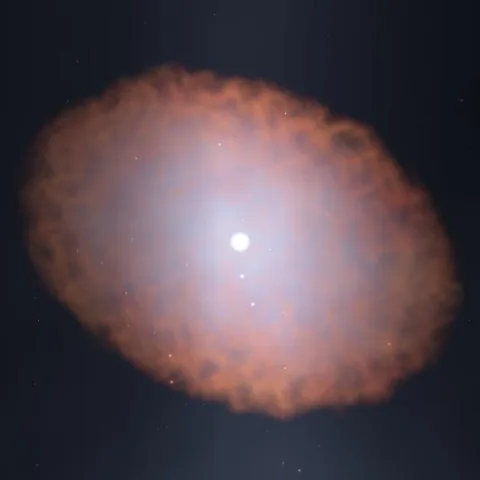
On 4 July 1054 Chinese astronomers recorded a new star in the constellation Taurus, bright enough to see by day for three weeks and by night for nearly two years. It was a star blowing itself apart, 6,500 light-years away, and what is left of it, 970 years on, is the Crab Nebula: a cloud of gas 11 light-years across, still expanding, with a pulsar at its heart.
- Distance
- About 6,500 light-years
- Width
- About 11 light-years, growing by about 1,500 km every second
- Kind
- Supernova remnant
- Seen in
- The constellation Taurus, near the star Zeta Tauri
- Centre
- A pulsar, a neutron star about 20 km across, spinning about 30 times a second
- Catalogue number
- M1, the first object in Messier's list
The guest star of 1054
Chinese court astronomers wrote of a 'guest star' that appeared in the summer of 1054 and was brighter than Venus. It was visible in daylight for 23 days and in the night sky for 653 days. It may also have been noted in Japan and the Arab world; European records of it are missing. Nobody knew what it was until the 20th century, when the nebula, which had been found in 1731, was seen to be growing, and traced back to a start about 900 years earlier.
The lighthouse at its heart
At the centre is what the star's core became: a neutron star, about one and a half times the Sun's mass and about 20 km across, spinning about 30 times a second. It sweeps beams of radio waves, light and X-rays round like a lighthouse, so it flashes at us 30 times a second: a pulsar. Its energy lights the whole nebula and keeps its glow bright long after the explosion.
Why 'Crab'?
The Irish astronomer Lord Rosse drew it in the 1840s with arms like claws and called it the Crab; the name stuck, though modern photographs look more like a ball of threads. Charles Messier saw it in 1758 while hunting for a comet, noted it as a fixed fuzzy patch that was not one, and made it number 1 in his list of things not to be mistaken for comets.
In Exo-View
The key below flies from the Sun to the Crab Nebula, a shell of orange and pink gas round a blue-white glow. The shape is drawn from the nebula's photographs, an artist's impression, and the plate says so. You can fly on to Betelgeuse, another star expected to end this way.
Fly to the Crab NebulaWatch Betelgeuse explodeMore from the sky
- Space simulations in 3D
- The total solar eclipse of 2 August 2027
- T Coronae Borealis, the Blaze Star
- When Betelgeuse explodes
- Meteor showers, through the year
- Falling into a black hole
- Where is the International Space Station right now?
- Every working satellite in orbit
- Where are the planets right now?
- A 3D map of the Milky Way
- Where is Mars right now?
- Where is Jupiter right now?
- Where is Saturn right now?
- The Moon in 3D: where it is and how it moves
- Proxima Centauri: the nearest star to the Sun
- TRAPPIST-1: seven Earth-sized planets round one small star
- Tau Ceti: the nearest single star like the Sun
- Barnard's Star: the fastest-moving star in the sky
- The Orion Nebula: where stars are born
- The Eagle Nebula and the Pillars of Creation
- The Helix Nebula: what will happen to the Sun
- Sagittarius A*: the black hole at the centre of the Milky Way
- Cygnus X-1: the first black hole anyone was sure of
- Gaia BH1: the nearest known black hole
- Sirius: the brightest star in the night sky
- Where is the James Webb Space Telescope right now?
- Where is the Hubble Space Telescope right now?
- Parker Solar Probe: the closest anyone has been to the Sun
- Where is Venus right now?
- Where is Mercury right now?
- Where is Uranus right now?
- Where is Neptune right now?
- Europa: a moon with an ocean under its ice
- Titan: the moon with lakes and weather
- Arcturus: the brightest star of the northern sky
- Teegarden's Star: a tiny star with Earth-mass planets
- The Horsehead Nebula: a cloud shaped like a horse
- The Carina Nebula: a star nursery with a star about to explode
- Gaia BH3: the heaviest black hole of its kind in the Milky Way
- Where is the Juno spacecraft right now?