Nebulae · pillars
The Eagle Nebula and the Pillars of Creation
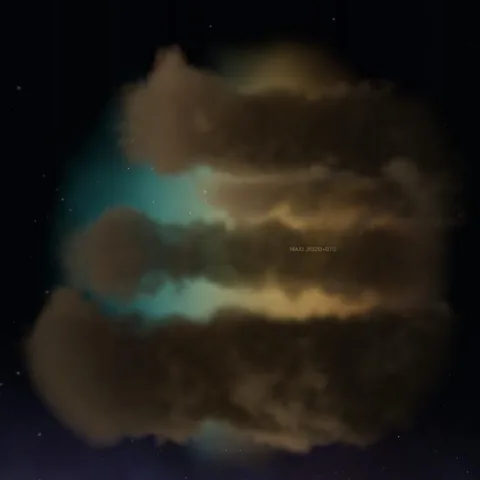
The Eagle Nebula, 7,000 light-years away in the constellation Serpens, holds one of the most famous pictures in astronomy: the Pillars of Creation, columns of cold gas and dust several light-years tall that the Hubble Space Telescope photographed in 1995. They are being eaten away by the light of stars that formed just above them, and new stars are forming inside their fingertips.
- Distance
- About 7,000 light-years
- Width
- About 70 light-years
- Pillars
- Up to about 5 light-years tall
- Kind
- Emission nebula with a young star cluster, NGC 6611
- Catalogue number
- M16
- Seen in
- The constellation Serpens, in summer in the north
Columns in a storm of light
A cluster of hot, young, massive stars sits just above the pillars and pours out ultraviolet light and a wind of particles. The light strips and heats the gas it hits, and carves away the thin cloud, leaving only the densest knots standing like pillars behind, because they shield the gas in their shadow. At the tip of each finger are small dark globules, dense enough that stars are forming inside them. As the pillar is eroded, each star is uncovered.
The most famous picture
Jeff Hester and Paul Scowen made the 1995 Hubble picture, and it has been reproduced more than almost any other in astronomy. In 2022 the James Webb Space Telescope photographed the pillars again in infrared, in which the dust turns transparent and the young stars shine through. The light we see left the pillars about 7,000 years ago; whether they still stand is a question astronomers have argued over, since a nearby supernova may have swept them away since.
In Exo-View
The key below flies from the Sun to the Eagle Nebula. Its shape is made from photographs of the pillars, so it is an artist's impression of a place no one has seen from outside, and the plate says so.
Fly to the Eagle NebulaSee the Milky WayMore from the sky
- Space simulations in 3D
- The total solar eclipse of 2 August 2027
- T Coronae Borealis, the Blaze Star
- When Betelgeuse explodes
- Meteor showers, through the year
- Falling into a black hole
- Where is the International Space Station right now?
- Every working satellite in orbit
- Where are the planets right now?
- A 3D map of the Milky Way
- Where is Mars right now?
- Where is Jupiter right now?
- Where is Saturn right now?
- The Moon in 3D: where it is and how it moves
- Proxima Centauri: the nearest star to the Sun
- TRAPPIST-1: seven Earth-sized planets round one small star
- Tau Ceti: the nearest single star like the Sun
- Barnard's Star: the fastest-moving star in the sky
- The Orion Nebula: where stars are born
- The Crab Nebula: what is left of a star that exploded in 1054
- The Helix Nebula: what will happen to the Sun
- Sagittarius A*: the black hole at the centre of the Milky Way
- Cygnus X-1: the first black hole anyone was sure of
- Gaia BH1: the nearest known black hole
- Sirius: the brightest star in the night sky
- Where is the James Webb Space Telescope right now?
- Where is the Hubble Space Telescope right now?
- Parker Solar Probe: the closest anyone has been to the Sun
- Where is Venus right now?
- Where is Mercury right now?
- Where is Uranus right now?
- Where is Neptune right now?
- Europa: a moon with an ocean under its ice
- Titan: the moon with lakes and weather
- Arcturus: the brightest star of the northern sky
- Teegarden's Star: a tiny star with Earth-mass planets
- The Horsehead Nebula: a cloud shaped like a horse
- The Carina Nebula: a star nursery with a star about to explode
- Gaia BH3: the heaviest black hole of its kind in the Milky Way
- Where is the Juno spacecraft right now?