Supernova · Betelgeuse
When Betelgeuse explodes
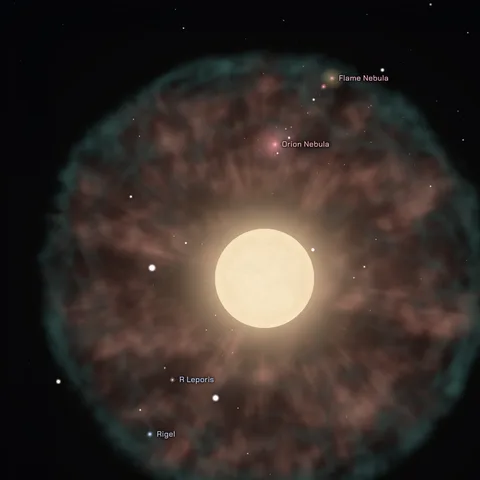
Betelgeuse, the red star at Orion's shoulder, is a supergiant near the end of its life. One day its core will collapse and the star will blow itself apart in a supernova — bright enough, for a few weeks, to cast shadows at night and to be seen in daylight.
- Where
- Orion's right shoulder — top left as seen from the Northern Hemisphere
- Distance
- About 550 light-years (estimates run from 500 to 650)
- Size
- Put where the Sun is, it would reach past the orbit of Mars
- When
- Most likely within the next 100,000 years
- At its brightest
- About as bright as a half Moon
Why it will explode
A star shines by fusing light elements into heavier ones in its core. A star the Sun's size stops at carbon and oxygen; one as massive as Betelgeuse — about fifteen to twenty times the Sun — goes on, through neon, oxygen and silicon, to iron. Fusing iron gives out no energy. When the iron core grows too heavy to hold itself up, it collapses in under a second into a neutron star, and the rest of the star rebounds off it and is blown outwards.
When
Not on any schedule we can read. Betelgeuse is thought to be in the last stage of its life, but for a star that means within about a hundred thousand years. The light we see left it about 550 years ago, so if it has already gone, we will not know until that light arrives.
Its Great Dimming of 2019–2020, when it lost more than half its brightness, was a cloud of dust it had thrown off, not a sign of the end.
Is it dangerous?
No. A supernova would have to be within about 50 light-years to harm Earth's ozone layer, and Betelgeuse is ten times further. We would see a star brighter than anything in the night sky but the Moon, fading over months, and then Orion without his shoulder.
In Exo-View
The simulation takes you to Betelgeuse at its measured place and plays the collapse from up close, then shows the sky as we would see it from Earth.
Watch Betelgeuse explode in 3D