Nova · T CrB, the Blaze Star
T Coronae Borealis, the Blaze Star
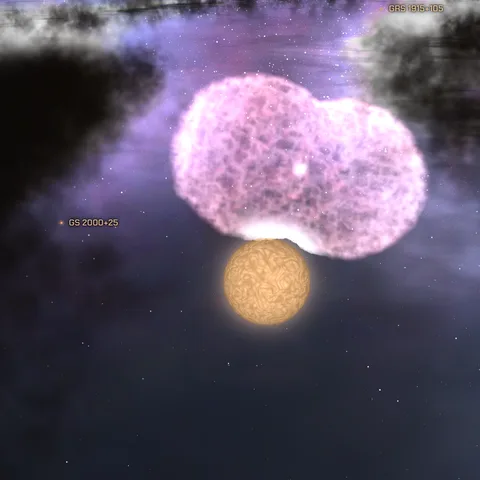
About 3,000 light-years away, in the Northern Crown, a white dwarf has been pulling hydrogen off a red giant for eighty years. When the layer ignites, a star too faint to see becomes, for a few nights, one of the brightest in the sky. It last happened in 1946, and it is due. Checked October 2026.
- Where
- Corona Borealis, the Northern Crown — between Arcturus and Vega
- Distance
- About 3,000 light-years
- Past eruptions
- 1866 and 1946
- At its peak
- About magnitude 2, as bright as the North Star
- How long
- A few nights to the naked eye, about a week in binoculars
What a nova is
T Coronae Borealis is two stars in one orbit: a red giant and a white dwarf, the dense core of a star that has finished burning. The white dwarf's gravity pulls gas off its companion, and the hydrogen settles on its surface. When enough has gathered, its base grows hot and dense enough to fuse all at once, and the layer is blown off in a thermonuclear flash. Both stars survive; the theft begins again.
Most novae take tens of thousands of years to repeat. T CrB is one of only ten known in our galaxy to do it within a human lifetime.
When
No one can say the day. In 2023 the star dimmed slightly, as it did about a year before the 1946 eruption, and astronomers have watched for it since. As of October 2026 it has not yet erupted. When it does, it brightens from magnitude 10 to about 2 within hours.
Where to look
Follow the curve of the Big Dipper's handle to Arcturus, the bright orange star, and find Vega, the bright white star high in summer skies. About a third of the way from Arcturus to Vega is the Northern Crown, a small semicircle of stars. The nova will appear just outside the crown's south-eastern edge, near the star Epsilon Coronae Borealis, as a new star that was not there the night before. It is best seen from the Northern Hemisphere, in the evening from spring to early autumn.
In Exo-View
The simulation flies you to T CrB at its real place in the galaxy and plays the eruption from close up: the gas streaming from the giant, the white dwarf's layer igniting, and the shell thrown off.
Watch the nova in 3D