Stars · the nearest
Proxima Centauri: the nearest star to the Sun
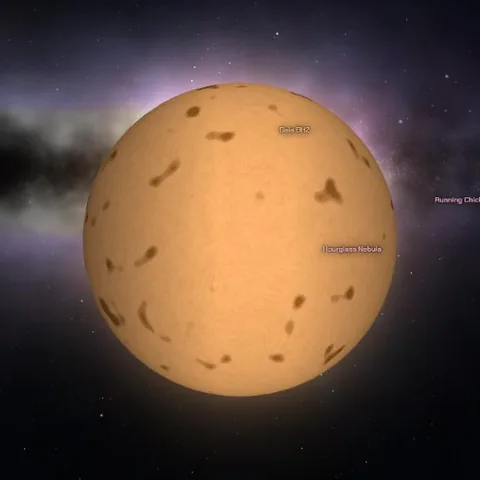
Proxima Centauri is the nearest star to the Sun, 4.25 light-years away: light from it has been travelling for four years and three months. It is a red dwarf too faint to see without a telescope, and it has at least two planets, one of them an Earth-sized world in the zone where water could be liquid. In Exo-View you can fly there from the Sun.
- Distance
- 4.25 light-years, about 40 trillion km
- Kind
- Red dwarf, spectral type M5.5
- Size
- 0.15 times the Sun's width, about one and a half times Jupiter's
- Surface temperature
- About 3,000 K, against the Sun's 5,800 K
- Brightness
- About 1/600 of the Sun's total light; magnitude 11, far below the naked-eye limit
- Spin
- Once in about 83 days
- Planets
- Proxima b, 11.2-day orbit, about Earth's mass; Proxima d, 5-day orbit, about a quarter of Earth's mass
The third star of Alpha Centauri
To the naked eye the nearest star system is Alpha Centauri, the bright point in the southern constellation of Centaurus, which is really two Sun-like stars close together. Proxima is a faint third member, found in 1915, circling the pair at a distance of about 13,000 times the gap between the Earth and the Sun, taking roughly half a million years to go round.
Its planets
In 2016 astronomers announced Proxima b, found by the way Proxima wobbles as it pulls on its star. It is at least about as heavy as the Earth, circles in 11 days, and sits in the habitable zone, where it gets about as much warmth as Earth does. It is very close to its star, so it is probably locked with one face to it, and Proxima's flares, which can double its brightness in minutes, would bathe it in X-rays. Whether it has air or water is unknown. In 2022 a smaller planet, Proxima d, was found closer in, a quarter of the Earth's mass.
How long to get there
Light takes 4.25 years. The fastest spacecraft that have left the solar system, the Voyagers, travel at about 17 km/s, and at that speed the journey would take about 75,000 years. That is why the star is a target for ideas, such as tiny sails pushed by lasers, rather than for a mission.
In Exo-View
The key below flies from the Sun to Proxima Centauri. Its two planets are drawn in their orbits, labelled as an illustration of the figures: nobody has a picture of an exoplanet, only a wobble in a star's light.
Fly to Proxima CentauriSee the Milky WayMore from the sky
- Space simulations in 3D
- The total solar eclipse of 2 August 2027
- T Coronae Borealis, the Blaze Star
- When Betelgeuse explodes
- Meteor showers, through the year
- Falling into a black hole
- Where is the International Space Station right now?
- Every working satellite in orbit
- Where are the planets right now?
- A 3D map of the Milky Way
- Where is Mars right now?
- Where is Jupiter right now?
- Where is Saturn right now?
- The Moon in 3D: where it is and how it moves
- TRAPPIST-1: seven Earth-sized planets round one small star
- Tau Ceti: the nearest single star like the Sun
- Barnard's Star: the fastest-moving star in the sky
- The Orion Nebula: where stars are born
- The Crab Nebula: what is left of a star that exploded in 1054
- The Eagle Nebula and the Pillars of Creation
- The Helix Nebula: what will happen to the Sun
- Sagittarius A*: the black hole at the centre of the Milky Way
- Cygnus X-1: the first black hole anyone was sure of
- Gaia BH1: the nearest known black hole
- Sirius: the brightest star in the night sky
- Where is the James Webb Space Telescope right now?
- Where is the Hubble Space Telescope right now?
- Parker Solar Probe: the closest anyone has been to the Sun
- Where is Venus right now?
- Where is Mercury right now?
- Where is Uranus right now?
- Where is Neptune right now?
- Europa: a moon with an ocean under its ice
- Titan: the moon with lakes and weather
- Arcturus: the brightest star of the northern sky
- Teegarden's Star: a tiny star with Earth-mass planets
- The Horsehead Nebula: a cloud shaped like a horse
- The Carina Nebula: a star nursery with a star about to explode
- Gaia BH3: the heaviest black hole of its kind in the Milky Way
- Where is the Juno spacecraft right now?