Black holes · the first
Cygnus X-1: the first black hole anyone was sure of
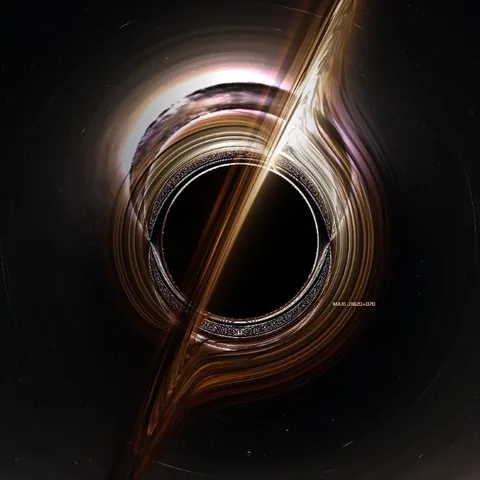
Cygnus X-1, in the constellation Cygnus the Swan, 7,240 light-years away, was the first object widely accepted as a black hole. It is 21 times the Sun's mass, circled every 5.6 days by a blue supergiant whose wind it is dragging into a disc of gas heated to millions of degrees. Exo-View flies you to it.
- Distance
- 7,240 light-years
- Mass
- About 21 Suns
- Horizon
- About 63 km in radius: a black hole of this mass is the size of a city
- Companion
- HDE 226868, a blue supergiant about 40 times the Sun's mass
- Orbit
- Every 5.6 days, at about a quarter of the Earth–Sun distance
- Found
- An X-ray source in 1964; accepted as a black hole by the early 1970s
How a black hole is seen
A black hole gives off no light of its own, but gas falling into one is squeezed and heated so much that it shines in X-rays. Cygnus X-1 was found in 1964 as a source of X-rays in a rocket flight above the atmosphere. In 1971 its position was matched with a blue supergiant, whose motion showed that it was circling something invisible, too heavy to be a neutron star. Nothing but a black hole fits.
A famous bet
In 1974 Stephen Hawking bet Kip Thorne that Cygnus X-1 was not a black hole, as insurance, he said, in case years of work on them came to nothing. By 1990 the evidence was in, and Hawking conceded. In 2021 a chain of radio telescopes across the United States fixed its distance and mass more tightly than ever, and showed that it is spinning very fast, close to the greatest rate a black hole can.
In Exo-View
The key below flies from the Sun to Cygnus X-1 and draws the hole with its disc, seen nearly face-on, the sky bent round it. A horizon only 63 km across is invisible at this scale, so the disc and the shadow are drawn enlarged, and the plate says so. For the fall itself, see the Simulations page.
Fly to Cygnus X-1See the Milky WayMore from the sky
- Space simulations in 3D
- The total solar eclipse of 2 August 2027
- T Coronae Borealis, the Blaze Star
- When Betelgeuse explodes
- Meteor showers, through the year
- Falling into a black hole
- Where is the International Space Station right now?
- Every working satellite in orbit
- Where are the planets right now?
- A 3D map of the Milky Way
- Where is Mars right now?
- Where is Jupiter right now?
- Where is Saturn right now?
- The Moon in 3D: where it is and how it moves
- Proxima Centauri: the nearest star to the Sun
- TRAPPIST-1: seven Earth-sized planets round one small star
- Tau Ceti: the nearest single star like the Sun
- Barnard's Star: the fastest-moving star in the sky
- The Orion Nebula: where stars are born
- The Crab Nebula: what is left of a star that exploded in 1054
- The Eagle Nebula and the Pillars of Creation
- The Helix Nebula: what will happen to the Sun
- Sagittarius A*: the black hole at the centre of the Milky Way
- Gaia BH1: the nearest known black hole
- Sirius: the brightest star in the night sky
- Where is the James Webb Space Telescope right now?
- Where is the Hubble Space Telescope right now?
- Parker Solar Probe: the closest anyone has been to the Sun
- Where is Venus right now?
- Where is Mercury right now?
- Where is Uranus right now?
- Where is Neptune right now?
- Europa: a moon with an ocean under its ice
- Titan: the moon with lakes and weather
- Arcturus: the brightest star of the northern sky
- Teegarden's Star: a tiny star with Earth-mass planets
- The Horsehead Nebula: a cloud shaped like a horse
- The Carina Nebula: a star nursery with a star about to explode
- Gaia BH3: the heaviest black hole of its kind in the Milky Way
- Where is the Juno spacecraft right now?