Stars · the brightest
Sirius: the brightest star in the night sky
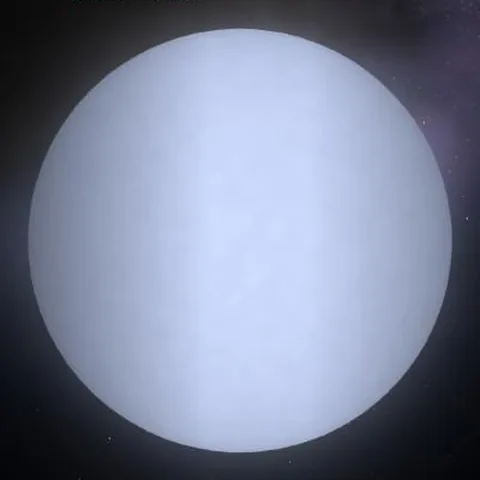
Sirius, the Dog Star, is the brightest star in the night sky and one of our nearest neighbours, 8.6 light-years away. It is a white star twice the Sun's mass, with a companion that was found because of the wobble it causes: Sirius B, a white dwarf the size of the Earth. Exo-View flies you there.
- Distance
- 8.6 light-years, the fifth-nearest star system
- Kind
- White star, spectral type A1
- Size
- 1.7 times the Sun's width, with twice its mass
- Light
- About 25 times the Sun's
- Surface temperature
- About 9,900 K, against the Sun's 5,800 K
- Companion
- Sirius B, a white dwarf with about the Sun's mass in the size of the Earth, circling every 50 years
- Seen in
- The constellation Canis Major, the Great Dog
Why it looks so bright
Sirius is not an unusually powerful star: it gives out about 25 times the Sun's light. It outshines every other star in our sky because it is so near: of the stars close enough to compare, only a few are nearer, and most of those are too faint to see. It is best seen on winter evenings in the northern hemisphere, low in the south-east, and its steady white-blue flickers in colour through our unsteady air.
The dog days
To the ancient Egyptians Sirius was Sopdet, and when it first showed in the dawn sky just before sunrise, in midsummer, the Nile was about to flood, so its return began their year. The Greeks and Romans called the hot weeks when it rises with the Sun the dog days, a name that is still used.
A companion the size of the Earth
In 1844 Friedrich Bessel saw that Sirius wobbles as if it were circling something unseen; in 1862 the telescope-maker Alvan Clark spotted the companion, Sirius B. It is a white dwarf, the bare core of a star that ran out of fuel, with about the Sun's mass packed into a ball about as wide as the Earth and a surface hotter than Sirius A's. It is 10,000 times fainter than the main star and hard to see next to its glare. It goes round Sirius A every 50 years.
In Exo-View
The key below flies from the Sun to Sirius. Its companion circles it, drawn on their real orbit and to their real sizes, so you can see how small a white dwarf is beside a star.
Fly to SiriusSee the Milky WayMore from the sky
- Space simulations in 3D
- The total solar eclipse of 2 August 2027
- T Coronae Borealis, the Blaze Star
- When Betelgeuse explodes
- Meteor showers, through the year
- Falling into a black hole
- Where is the International Space Station right now?
- Every working satellite in orbit
- Where are the planets right now?
- A 3D map of the Milky Way
- Where is Mars right now?
- Where is Jupiter right now?
- Where is Saturn right now?
- The Moon in 3D: where it is and how it moves
- Proxima Centauri: the nearest star to the Sun
- TRAPPIST-1: seven Earth-sized planets round one small star
- Tau Ceti: the nearest single star like the Sun
- Barnard's Star: the fastest-moving star in the sky
- The Orion Nebula: where stars are born
- The Crab Nebula: what is left of a star that exploded in 1054
- The Eagle Nebula and the Pillars of Creation
- The Helix Nebula: what will happen to the Sun
- Sagittarius A*: the black hole at the centre of the Milky Way
- Cygnus X-1: the first black hole anyone was sure of
- Gaia BH1: the nearest known black hole
- Where is the James Webb Space Telescope right now?
- Where is the Hubble Space Telescope right now?
- Parker Solar Probe: the closest anyone has been to the Sun
- Where is Venus right now?
- Where is Mercury right now?
- Where is Uranus right now?
- Where is Neptune right now?
- Europa: a moon with an ocean under its ice
- Titan: the moon with lakes and weather
- Arcturus: the brightest star of the northern sky
- Teegarden's Star: a tiny star with Earth-mass planets
- The Horsehead Nebula: a cloud shaped like a horse
- The Carina Nebula: a star nursery with a star about to explode
- Gaia BH3: the heaviest black hole of its kind in the Milky Way
- Where is the Juno spacecraft right now?