Space telescopes · Webb
Where is the James Webb Space Telescope right now?
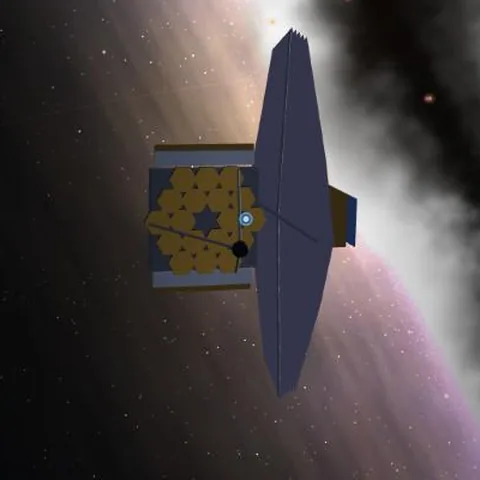
The James Webb Space Telescope is about 1.5 million km from the Earth, four times as far as the Moon, on the side away from the Sun. It circles a point called L2 where the gravity of the Sun and the Earth together hold it in line with them. Exo-View shows where it is today and lets you fly to it.
- Distance
- About 1.5 million km from Earth: a signal takes 5 seconds
- Place
- In a halo orbit round L2, the Sun–Earth point on the far side from the Sun
- Mirror
- 6.5 m across, 18 gold-coated beryllium segments
- Sunshield
- Five layers, about the size of a tennis court
- Sees
- Infrared light, from orange light to the mid-infrared
- Temperature
- About −233 °C on the cold side
- Launched
- 25 December 2021, on an Ariane 5; first images in July 2022
Why so far away?
Webb sees heat, and anything warm near it would blind it, so it has to be far from the Earth, Moon and Sun. At L2 all three are in the same direction, behind a sunshield that keeps its mirror and instruments at about −233 °C. The point is not steady, so Webb loops round it, in an orbit of about six months, and uses a little fuel to stay there. It has enough for over twenty years.
What it sees
The light of the first stars and galaxies has been stretched by the expansion of the universe from visible light to infrared, which is why Webb was built to see in infrared. It has found galaxies as they were less than 400 million years after the Big Bang, read the air of planets round other stars, and looked inside the dust of nurseries like the Pillars of Creation. Hubble, which sees mainly visible light, is the other half of the pair.
In Exo-View
The key below switches the Spacecraft layer on and flies to Webb, a model with its shield between it and the Sun. Its place is taken from NASA's Horizons system, and like all positions on the site it is approximate. Its plate gives its distance from the Sun and the Earth and its speed.
Fly to the Webb telescopeVisit HubbleMore from the sky
- Space simulations in 3D
- The total solar eclipse of 2 August 2027
- T Coronae Borealis, the Blaze Star
- When Betelgeuse explodes
- Meteor showers, through the year
- Falling into a black hole
- Where is the International Space Station right now?
- Every working satellite in orbit
- Where are the planets right now?
- A 3D map of the Milky Way
- Where is Mars right now?
- Where is Jupiter right now?
- Where is Saturn right now?
- The Moon in 3D: where it is and how it moves
- Proxima Centauri: the nearest star to the Sun
- TRAPPIST-1: seven Earth-sized planets round one small star
- Tau Ceti: the nearest single star like the Sun
- Barnard's Star: the fastest-moving star in the sky
- The Orion Nebula: where stars are born
- The Crab Nebula: what is left of a star that exploded in 1054
- The Eagle Nebula and the Pillars of Creation
- The Helix Nebula: what will happen to the Sun
- Sagittarius A*: the black hole at the centre of the Milky Way
- Cygnus X-1: the first black hole anyone was sure of
- Gaia BH1: the nearest known black hole
- Sirius: the brightest star in the night sky
- Where is the Hubble Space Telescope right now?
- Parker Solar Probe: the closest anyone has been to the Sun
- Where is Venus right now?
- Where is Mercury right now?
- Where is Uranus right now?
- Where is Neptune right now?
- Europa: a moon with an ocean under its ice
- Titan: the moon with lakes and weather
- Arcturus: the brightest star of the northern sky
- Teegarden's Star: a tiny star with Earth-mass planets
- The Horsehead Nebula: a cloud shaped like a horse
- The Carina Nebula: a star nursery with a star about to explode
- Gaia BH3: the heaviest black hole of its kind in the Milky Way
- Where is the Juno spacecraft right now?