Solar system · Venus
Where is Venus right now?
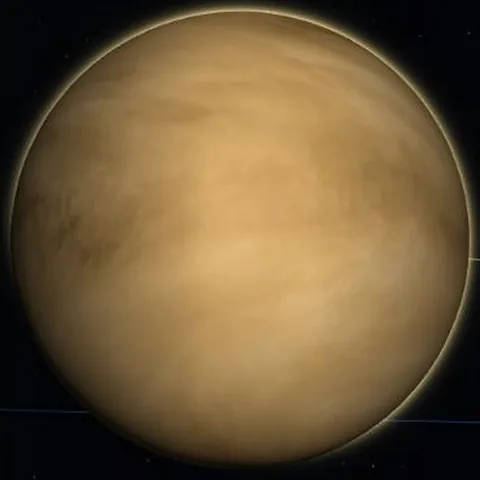
Venus is the planet that comes nearest to the Earth, and the brightest thing in the sky after the Sun and the Moon. It goes round the Sun in 225 days, so it swings from the evening sky to the morning sky and back about every 19 months. Exo-View puts it where it is at this moment and lets you fly in to it.
- Orbit
- 224.7 days
- Distance from the Sun
- 0.72 AU, about 108 million km
- Distance from Earth
- From about 38 million km to about 260 million km
- Width
- 12,104 km, a little less than the Earth's
- Day
- It turns once in 243 Earth days, backwards: one spin is longer than its year
- Surface
- About 465 °C, hotter than Mercury, under air about 90 times as thick as ours
The evening star and the morning star
Venus is closer to the Sun than we are, so from the Earth it never strays far from it: at most 47° away. It shines in the west after sunset, as the evening star, or in the east before sunrise, as the morning star, and it changes from one to the other about every ten months. At its best it is far brighter than any star, bright enough to throw a faint shadow. Through a small telescope it shows phases, like the Moon, which Galileo saw in 1610 and which showed that the planets go round the Sun.
A runaway greenhouse
Venus is almost the Earth's twin in size, but its thick air of carbon dioxide traps the heat so well that its surface is hot enough to melt lead, with clouds of sulfuric acid above. It turns backwards and very slowly, so the Sun rises in the west, and from one sunrise to the next takes about 117 Earth days. Its clouds are unbroken and bright, which is why photographs show no surface at all. Radar has mapped the ground beneath. The only craft that sent pictures from it, the Soviet Venera landers, lasted at most about two hours.
Crossing the Sun
Venus sometimes passes exactly across the Sun's face, a transit. They come in pairs eight years apart, then none for more than a century. The last were in 2004 and 2012, and the next will be in December 2117.
In Exo-View
The button below flies from the Sun to Venus, drawn as its clouds look from outside. Open its plate for its figures, and run the clock forward to watch it pass the Earth.
Fly to VenusSee every planetMore from the sky
- Space simulations in 3D
- The total solar eclipse of 2 August 2027
- T Coronae Borealis, the Blaze Star
- When Betelgeuse explodes
- Meteor showers, through the year
- Falling into a black hole
- Where is the International Space Station right now?
- Every working satellite in orbit
- Where are the planets right now?
- A 3D map of the Milky Way
- Where is Mars right now?
- Where is Jupiter right now?
- Where is Saturn right now?
- The Moon in 3D: where it is and how it moves
- Proxima Centauri: the nearest star to the Sun
- TRAPPIST-1: seven Earth-sized planets round one small star
- Tau Ceti: the nearest single star like the Sun
- Barnard's Star: the fastest-moving star in the sky
- The Orion Nebula: where stars are born
- The Crab Nebula: what is left of a star that exploded in 1054
- The Eagle Nebula and the Pillars of Creation
- The Helix Nebula: what will happen to the Sun
- Sagittarius A*: the black hole at the centre of the Milky Way
- Cygnus X-1: the first black hole anyone was sure of
- Gaia BH1: the nearest known black hole
- Sirius: the brightest star in the night sky
- Where is the James Webb Space Telescope right now?
- Where is the Hubble Space Telescope right now?
- Parker Solar Probe: the closest anyone has been to the Sun
- Where is Mercury right now?
- Where is Uranus right now?
- Where is Neptune right now?
- Europa: a moon with an ocean under its ice
- Titan: the moon with lakes and weather
- Arcturus: the brightest star of the northern sky
- Teegarden's Star: a tiny star with Earth-mass planets
- The Horsehead Nebula: a cloud shaped like a horse
- The Carina Nebula: a star nursery with a star about to explode
- Gaia BH3: the heaviest black hole of its kind in the Milky Way
- Where is the Juno spacecraft right now?