Moons · Saturn
Titan: the moon with lakes and weather
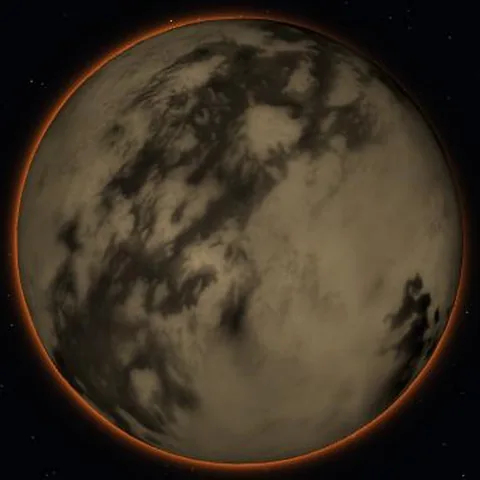
Titan, Saturn's largest moon, is bigger than Mercury and the only moon with a thick atmosphere, denser than Earth's. It has rivers, lakes and seas, not of water but of liquid methane and ethane, and rain, clouds and dunes. Exo-View puts it where it is now, going round Saturn.
- Orbit
- 15.9 days round Saturn, at 1.22 million km
- Width
- 5,149 km, bigger than Mercury
- Air
- Mostly nitrogen, with about 1.5 times the pressure at the Earth's surface
- Surface temperature
- About −179 °C
- Gravity
- About one seventh of the Earth's
- Found
- In 1655 by Christiaan Huygens
Weather on a cold world
Titan's orange haze hides the surface from view, but radar and infrared cameras, and the Cassini spacecraft, which orbited Saturn from 2004 to 2017, saw through it. They found dunes of dark organic grains, mountains, and lakes and seas near the poles, the largest bigger than the Caspian Sea. Methane does there what water does here: it evaporates, forms clouds, rains and carves river valleys.
The probe that landed
On 14 January 2005 Huygens, a probe carried by Cassini and built in Europe, parachuted through Titan's air and landed on its surface, the most distant landing ever made. It sent back pictures of a flat orange plain strewn with rounded pebbles of ice, for more than an hour. It is still the only landing on a moon in the outer solar system.
Next
NASA's Dragonfly, a rotorcraft the size of a small car, is due to launch in 2028 and arrive in 2034. In Titan's thick air and weak gravity it can fly from place to place, sampling the organic chemistry that may be like the Earth's before life began.
In Exo-View
The button below flies from the Sun to Titan, drawn from its surface maps. Open its plate for its figures, and fly on to Saturn and its rings.
Fly to TitanSee SaturnMore from the sky
- Space simulations in 3D
- The total solar eclipse of 2 August 2027
- T Coronae Borealis, the Blaze Star
- When Betelgeuse explodes
- Meteor showers, through the year
- Falling into a black hole
- Where is the International Space Station right now?
- Every working satellite in orbit
- Where are the planets right now?
- A 3D map of the Milky Way
- Where is Mars right now?
- Where is Jupiter right now?
- Where is Saturn right now?
- The Moon in 3D: where it is and how it moves
- Proxima Centauri: the nearest star to the Sun
- TRAPPIST-1: seven Earth-sized planets round one small star
- Tau Ceti: the nearest single star like the Sun
- Barnard's Star: the fastest-moving star in the sky
- The Orion Nebula: where stars are born
- The Crab Nebula: what is left of a star that exploded in 1054
- The Eagle Nebula and the Pillars of Creation
- The Helix Nebula: what will happen to the Sun
- Sagittarius A*: the black hole at the centre of the Milky Way
- Cygnus X-1: the first black hole anyone was sure of
- Gaia BH1: the nearest known black hole
- Sirius: the brightest star in the night sky
- Where is the James Webb Space Telescope right now?
- Where is the Hubble Space Telescope right now?
- Parker Solar Probe: the closest anyone has been to the Sun
- Where is Venus right now?
- Where is Mercury right now?
- Where is Uranus right now?
- Where is Neptune right now?
- Europa: a moon with an ocean under its ice
- Arcturus: the brightest star of the northern sky
- Teegarden's Star: a tiny star with Earth-mass planets
- The Horsehead Nebula: a cloud shaped like a horse
- The Carina Nebula: a star nursery with a star about to explode
- Gaia BH3: the heaviest black hole of its kind in the Milky Way
- Where is the Juno spacecraft right now?