Black holes · a heavy one
Gaia BH3: the heaviest black hole of its kind in the Milky Way
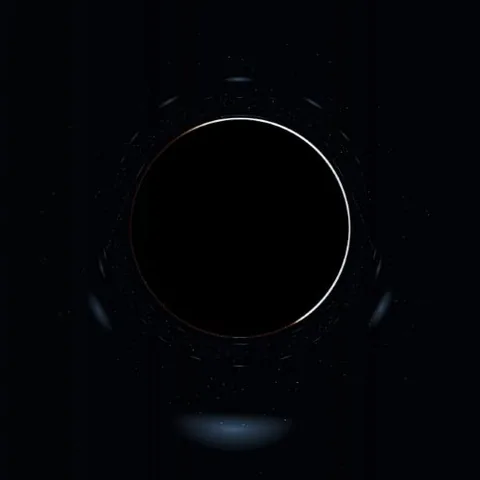
Gaia BH3 is a black hole of 33 Suns, 1,940 light-years away in the constellation Aquila, the second nearest known and the heaviest of its kind, made by a star, in our galaxy. It was found in 2024, when the European Gaia telescope noticed an ancient star swinging round something invisible every eleven and a half years.
- Distance
- About 1,940 light-years
- Mass
- About 33 Suns
- Companion
- An old giant star, LS II +14 13, going round it every 11.6 years
- Kind
- Dormant black hole: no disc, no X-rays
- Found
- In 2024, in data from the Gaia satellite
Why it is so heavy
Stars that formed early in the history of the galaxy had very few heavy elements, and such stars lose less of their mass in winds as they age. That leaves more mass behind to collapse into a black hole. The star that orbits Gaia BH3 is itself almost pure hydrogen and helium, as the first stars were, which suggests that the black hole formed from a star of that kind.
A neighbour of the first Gaia find
Gaia BH3 was spotted in a check of the data that was being prepared for the next big release, and the team announced it early, because it was so unusual. Like Gaia BH1, it is quiet: it is only seen by its pull on its star. Its companion belongs to a stream of stars, the remains of a small cluster that was pulled apart by the Milky Way long ago.
In Exo-View
The button below flies from the Sun to Gaia BH3. With no disc to draw, the hole is a black shadow with a thin ring of bent starlight. It is enlarged for the eye, and the plate says so.
Fly to Gaia BH3See Gaia BH1More from the sky
- Space simulations in 3D
- The total solar eclipse of 2 August 2027
- T Coronae Borealis, the Blaze Star
- When Betelgeuse explodes
- Meteor showers, through the year
- Falling into a black hole
- Where is the International Space Station right now?
- Every working satellite in orbit
- Where are the planets right now?
- A 3D map of the Milky Way
- Where is Mars right now?
- Where is Jupiter right now?
- Where is Saturn right now?
- The Moon in 3D: where it is and how it moves
- Proxima Centauri: the nearest star to the Sun
- TRAPPIST-1: seven Earth-sized planets round one small star
- Tau Ceti: the nearest single star like the Sun
- Barnard's Star: the fastest-moving star in the sky
- The Orion Nebula: where stars are born
- The Crab Nebula: what is left of a star that exploded in 1054
- The Eagle Nebula and the Pillars of Creation
- The Helix Nebula: what will happen to the Sun
- Sagittarius A*: the black hole at the centre of the Milky Way
- Cygnus X-1: the first black hole anyone was sure of
- Gaia BH1: the nearest known black hole
- Sirius: the brightest star in the night sky
- Where is the James Webb Space Telescope right now?
- Where is the Hubble Space Telescope right now?
- Parker Solar Probe: the closest anyone has been to the Sun
- Where is Venus right now?
- Where is Mercury right now?
- Where is Uranus right now?
- Where is Neptune right now?
- Europa: a moon with an ocean under its ice
- Titan: the moon with lakes and weather
- Arcturus: the brightest star of the northern sky
- Teegarden's Star: a tiny star with Earth-mass planets
- The Horsehead Nebula: a cloud shaped like a horse
- The Carina Nebula: a star nursery with a star about to explode
- Where is the Juno spacecraft right now?