Galaxy · a 3D map
A 3D map of the Milky Way
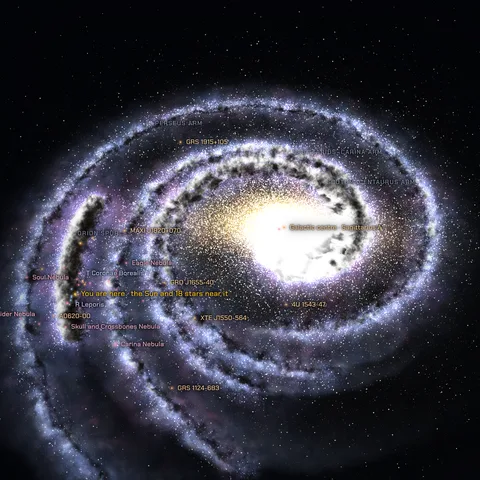
Nobody has ever seen the Milky Way from outside: we live inside it, about halfway from its centre to its edge. Every map of it is built from measurements made from here, and a good map says which parts are measured and which are drawn. In Exo-View 32,639 real stars stand where they have been measured, and you can fly from the galaxy's edge in to the Sun.
- Width
- About 100,000 light-years across
- Thickness
- About 1,000 light-years through the disc
- Stars
- Somewhere between 100 and 400 billion
- Where the Sun is
- About 26,000 light-years from the centre, in a minor arm called the Orion Spur
- One lap of the galaxy
- About 230 million years, for the Sun
- At its centre
- A black hole of about four million Suns, Sagittarius A*
How do we know its shape?
We cannot step outside, so we measure from within. A star's distance can be found from how far it seems to shift against the background as the Earth goes round the Sun, its parallax: the Hipparcos satellite did this for over a hundred thousand stars, and its successor Gaia for more than a billion.
Beyond a few thousand light-years the method runs out, and the far side of the galaxy is traced another way: by the glow of star-forming gas and the motion of clouds, seen in radio and infrared light. That is how the spiral arms were found.
What is measured, and what is drawn
Every place in Exo-View is marked for which it is. Where the stars are and how bright, and the distances to the nebulae and black holes, are measured. How long light takes to reach you, and how big things are against each other, are worked out. The galaxy seen from outside is drawn, its arms following their measured spiral, and so are the shapes of the nebulae, from what is known of their kind. Each card says which.
What you can visit
The map holds the nearest stars with the planets found round them — Proxima Centauri, Barnard's Star, TRAPPIST-1 and more — and nebulae and black holes at their measured distances, among them Cygnus X-1, about 7,200 light-years away. Pick one and the camera flies there.
In Exo-View
The key below opens on the galaxy itself, seen from above. A journey runs from its edge past the nebulae and black holes to the stars round the Sun, and on to the planets, where we are now.
Fly through the Milky WayFly out to the planets