Solar system · the Moon
The Moon in 3D: where it is and how it moves
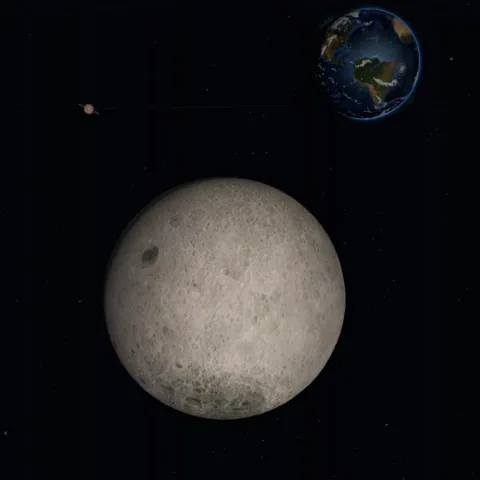
The Moon is the one other world people have stood on, and it goes round the Earth once every 27 days at an average of 384,400 km. Exo-View puts it where it is at this moment, circling the Earth at the scale of the real orbit, and lets you fly out to it.
- Distance
- 384,400 km on average: 356,500 km at its nearest, 406,700 km at its farthest
- Orbit
- 27.3 days round the Earth; 29.5 days from one new Moon to the next
- Width
- 3,475 km, about a quarter of the Earth's
- Light from it
- Takes 1.3 seconds to reach us
- Gravity
- About one sixth of Earth's
- Temperature
- From about 127 °C in sunlight to about −173 °C in the dark
- Walked on by
- Twelve people, from 1969 to 1972
Why we always see the same face
The Moon turns once on its axis in exactly the time it takes to go once round the Earth, 27.3 days, so the same side always faces us. The far side, which we never see from Earth, has a thicker crust and far fewer dark plains. It is not dark, only unseen: it has as much sunshine as the near side.
Phases, and why not every month has an eclipse
The phases are the Moon going round the Earth while the Sun lights half of it: new when it is between us and the Sun, full when we are between them. That takes 29.5 days, two days longer than the orbit itself, because the Earth moves on round the Sun meanwhile.
If the Moon's orbit lay in the same plane as the Earth's, every new Moon would eclipse the Sun and every full Moon would be eclipsed. Its orbit is tilted by about 5°, so the shadows usually pass above or below, and eclipses only come when a new or full Moon falls at the place where the two planes cross.
Where it came from, and where it is going
Most astronomers think the Moon formed about 4.5 billion years ago, when a planet about the size of Mars hit the young Earth and the debris gathered into a ball. It is moving away from us by about 3.8 cm a year, and it was much closer once: the day was shorter, and the Moon filled more of the sky.
In Exo-View
The key below flies to the Moon with the Earth beside it, at the real scale of the gap between them. Run the clock forward to watch it go round, or watch the total solar eclipse of 2 August 2027 in the simulation, where the Moon's shadow crosses Spain, Egypt and Arabia.
Fly to the MoonWatch the 2027 eclipseMore from the sky
- Space simulations in 3D
- The total solar eclipse of 2 August 2027
- T Coronae Borealis, the Blaze Star
- When Betelgeuse explodes
- Meteor showers, through the year
- Falling into a black hole
- Where is the International Space Station right now?
- Every working satellite in orbit
- Where are the planets right now?
- A 3D map of the Milky Way
- Where is Mars right now?
- Where is Jupiter right now?
- Where is Saturn right now?
- Proxima Centauri: the nearest star to the Sun
- TRAPPIST-1: seven Earth-sized planets round one small star
- Tau Ceti: the nearest single star like the Sun
- Barnard's Star: the fastest-moving star in the sky
- The Orion Nebula: where stars are born
- The Crab Nebula: what is left of a star that exploded in 1054
- The Eagle Nebula and the Pillars of Creation
- The Helix Nebula: what will happen to the Sun
- Sagittarius A*: the black hole at the centre of the Milky Way
- Cygnus X-1: the first black hole anyone was sure of
- Gaia BH1: the nearest known black hole
- Sirius: the brightest star in the night sky
- Where is the James Webb Space Telescope right now?
- Where is the Hubble Space Telescope right now?
- Parker Solar Probe: the closest anyone has been to the Sun
- Where is Venus right now?
- Where is Mercury right now?
- Where is Uranus right now?
- Where is Neptune right now?
- Europa: a moon with an ocean under its ice
- Titan: the moon with lakes and weather
- Arcturus: the brightest star of the northern sky
- Teegarden's Star: a tiny star with Earth-mass planets
- The Horsehead Nebula: a cloud shaped like a horse
- The Carina Nebula: a star nursery with a star about to explode
- Gaia BH3: the heaviest black hole of its kind in the Milky Way
- Where is the Juno spacecraft right now?