Stars · the fastest
Barnard's Star: the fastest-moving star in the sky
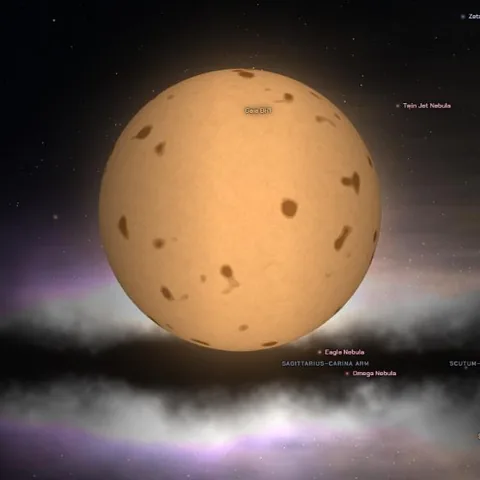
Barnard's Star is the nearest single star to the Sun, 6 light-years away, and the star that moves fastest across our sky: it covers the width of the full Moon every 180 years. It is a faint red dwarf in the constellation Ophiuchus, and it has a planet.
- Distance
- 5.96 light-years
- Kind
- Red dwarf, spectral type M4
- Size
- 0.2 times the Sun's width
- Surface temperature
- About 3,130 K
- Motion on the sky
- 10.4 arcseconds a year: the full Moon's width in about 180 years
- Age
- Probably about 10 billion years, more than twice the Sun's
- Planet
- Barnard's Star b, a 3-day orbit, about a third of the Earth's mass
Barnard's runaway
Almost all stars seem fixed to us, but over years the nearest ones drift against the background, and Barnard's Star drifts fastest of all, discovered in 1916 by the American astronomer Edward Barnard. It is not racing across space; it is simply near. It is also coming towards us, at about 110 km/s, and in about 12,000 years it will pass us at about 3.8 light-years, and be for a while the nearest star of all.
A planet, found after sixty years
In the 1960s an astronomer claimed to see planets pulling Barnard's Star about, and the claim was proved false. A cold planet reported in 2018 did not survive further observation either. In 2024 a team using the ESPRESSO instrument found a different one, Barnard's Star b: about a third of the mass of the Earth, closer to its star than Mercury is to the Sun, orbiting every 3.15 days. It is far too hot for liquid water. In 2025 astronomers reported three more small candidates.
In Exo-View
The key below flies from the Sun to Barnard's Star, which lies in the direction of the Milky Way's centre. The planet is drawn in its orbit as an illustration made from its figures: no one has a picture of it, and the plate says so.
Fly to Barnard's StarSee the Milky WayMore from the sky
- Space simulations in 3D
- The total solar eclipse of 2 August 2027
- T Coronae Borealis, the Blaze Star
- When Betelgeuse explodes
- Meteor showers, through the year
- Falling into a black hole
- Where is the International Space Station right now?
- Every working satellite in orbit
- Where are the planets right now?
- A 3D map of the Milky Way
- Where is Mars right now?
- Where is Jupiter right now?
- Where is Saturn right now?
- The Moon in 3D: where it is and how it moves
- Proxima Centauri: the nearest star to the Sun
- TRAPPIST-1: seven Earth-sized planets round one small star
- Tau Ceti: the nearest single star like the Sun
- The Orion Nebula: where stars are born
- The Crab Nebula: what is left of a star that exploded in 1054
- The Eagle Nebula and the Pillars of Creation
- The Helix Nebula: what will happen to the Sun
- Sagittarius A*: the black hole at the centre of the Milky Way
- Cygnus X-1: the first black hole anyone was sure of
- Gaia BH1: the nearest known black hole
- Sirius: the brightest star in the night sky
- Where is the James Webb Space Telescope right now?
- Where is the Hubble Space Telescope right now?
- Parker Solar Probe: the closest anyone has been to the Sun
- Where is Venus right now?
- Where is Mercury right now?
- Where is Uranus right now?
- Where is Neptune right now?
- Europa: a moon with an ocean under its ice
- Titan: the moon with lakes and weather
- Arcturus: the brightest star of the northern sky
- Teegarden's Star: a tiny star with Earth-mass planets
- The Horsehead Nebula: a cloud shaped like a horse
- The Carina Nebula: a star nursery with a star about to explode
- Gaia BH3: the heaviest black hole of its kind in the Milky Way
- Where is the Juno spacecraft right now?