Solar system · Uranus
Where is Uranus right now?
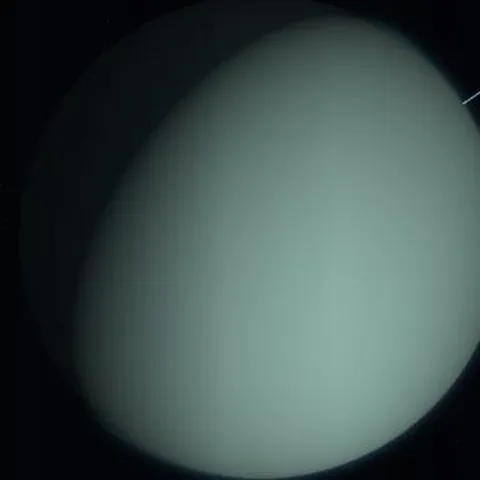
Uranus is the planet that lies on its side. It takes 84 years to go once round the Sun, at about 19 times the Earth's distance, and it spins tipped over by almost 98°. It was the first planet found with a telescope, in 1781. Exo-View puts it where it is at this moment.
- Orbit
- 84 years
- Distance from the Sun
- 19.2 AU on average, about 2.87 billion km
- Width
- 50,724 km, four times the Earth's
- Day
- About 17 hours
- Tilt
- 97.8°: it rolls round the Sun on its side
- Temperature
- About −224 °C at the cloud tops, the coldest planetary air known
- Moons and rings
- More than twenty-five moons, thirteen faint rings
Found by chance
On 13 March 1781 the musician and astronomer William Herschel noticed a faint object in Gemini that was not a star: it showed a tiny disc and moved from night to night. At first he took it for a comet. It was a planet, and the first not known since ancient times. Uranus is just visible to the naked eye under a very dark sky, as a point at the limit of sight, and it had been recorded as a star many times before.
Why it is on its side
Something knocked Uranus over, probably a giant impact early in its history. Because of the tilt, each pole spends 21 years in sunlight followed by 21 years in darkness, so that its seasons are very long, and its rings and moons circle at right angles to the way they do round other planets. It is an ice giant: mostly water, ammonia and methane around a rocky core, and the methane in its air absorbs red light, giving it its pale blue-green colour.
One visit
Only one spacecraft has ever been to Uranus, Voyager 2, which passed it on 24 January 1986 and found new moons, rings and a magnetic field tipped away from the planet's axis. Uranus's moons are named for characters of Shakespeare and Pope, among them Titania, Oberon and Miranda. A mission to orbit it has been called the highest priority for the next decade of planetary science.
In Exo-View
The button below flies from the Sun out to Uranus. The clock runs faster than life, so you can watch it creep along its 84-year orbit.
Fly to UranusSee every planetMore from the sky
- Space simulations in 3D
- The total solar eclipse of 2 August 2027
- T Coronae Borealis, the Blaze Star
- When Betelgeuse explodes
- Meteor showers, through the year
- Falling into a black hole
- Where is the International Space Station right now?
- Every working satellite in orbit
- Where are the planets right now?
- A 3D map of the Milky Way
- Where is Mars right now?
- Where is Jupiter right now?
- Where is Saturn right now?
- The Moon in 3D: where it is and how it moves
- Proxima Centauri: the nearest star to the Sun
- TRAPPIST-1: seven Earth-sized planets round one small star
- Tau Ceti: the nearest single star like the Sun
- Barnard's Star: the fastest-moving star in the sky
- The Orion Nebula: where stars are born
- The Crab Nebula: what is left of a star that exploded in 1054
- The Eagle Nebula and the Pillars of Creation
- The Helix Nebula: what will happen to the Sun
- Sagittarius A*: the black hole at the centre of the Milky Way
- Cygnus X-1: the first black hole anyone was sure of
- Gaia BH1: the nearest known black hole
- Sirius: the brightest star in the night sky
- Where is the James Webb Space Telescope right now?
- Where is the Hubble Space Telescope right now?
- Parker Solar Probe: the closest anyone has been to the Sun
- Where is Venus right now?
- Where is Mercury right now?
- Where is Neptune right now?
- Europa: a moon with an ocean under its ice
- Titan: the moon with lakes and weather
- Arcturus: the brightest star of the northern sky
- Teegarden's Star: a tiny star with Earth-mass planets
- The Horsehead Nebula: a cloud shaped like a horse
- The Carina Nebula: a star nursery with a star about to explode
- Gaia BH3: the heaviest black hole of its kind in the Milky Way
- Where is the Juno spacecraft right now?