Space probes · the Sun
Parker Solar Probe: the closest anyone has been to the Sun
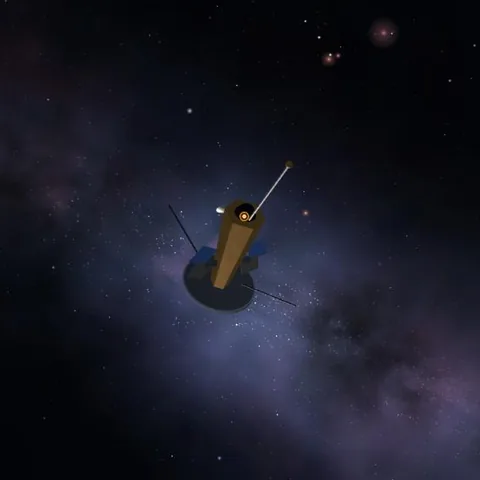
The Parker Solar Probe has flown closer to the Sun than any spacecraft before it, passing through its outer atmosphere, the corona, at about 190 km a second, the fastest speed any human-made thing has reached. Exo-View shows where it is today and lets you fly alongside it.
- Closest to the Sun
- About 6.1 million km from its surface, on 24 December 2024
- Top speed
- About 190 km/s, or 690,000 km/h
- Heat shield
- 11.5 cm of carbon foam, facing about 1,400 °C while the craft behind it stays near room temperature
- Launched
- 12 August 2018
- Mass
- 685 kg
- Orbit
- Seven passes by Venus tightened it, to a loop round the Sun of 88 days
Touching the Sun
In April 2021 Parker flew through the corona, the Sun's hot outer atmosphere, and so became the first spacecraft to 'touch' the Sun. The corona is millions of degrees, hotter than the surface, and nobody knows exactly why. Parker's instruments sample the solar wind, the stream of particles that leaves the Sun, where it is born, and have shown that its flow is made of twisting, switchback-shaped kinks in the Sun's magnetic field.
Why it does not melt
Space is cold, and Parker is hot only on one face. A shield 2.4 m wide takes the heat while the craft sits in its shadow, and its solar panels fold back into the shade as it nears the Sun. Its path was shaped by Venus: each pass of the planet pulled it into a smaller orbit, the last in December 2024 leaving it on a loop that comes in close every 88 days.
Named for a living scientist
Eugene Parker proposed in 1958 that the Sun must blow a stream of particles through space, which he called the solar wind. People doubted him, until probes found it. Parker's was the first NASA spacecraft named for someone who was alive to see it launch.
In Exo-View
The key below flies from the Sun out to the probe, seen with its shield and its antenna, with the trails of its orbits round the Sun beside it. Its place comes from NASA's Horizons system, and like all the positions here is approximate.
Fly to the Parker Solar ProbeFly to the SunMore from the sky
- Space simulations in 3D
- The total solar eclipse of 2 August 2027
- T Coronae Borealis, the Blaze Star
- When Betelgeuse explodes
- Meteor showers, through the year
- Falling into a black hole
- Where is the International Space Station right now?
- Every working satellite in orbit
- Where are the planets right now?
- A 3D map of the Milky Way
- Where is Mars right now?
- Where is Jupiter right now?
- Where is Saturn right now?
- The Moon in 3D: where it is and how it moves
- Proxima Centauri: the nearest star to the Sun
- TRAPPIST-1: seven Earth-sized planets round one small star
- Tau Ceti: the nearest single star like the Sun
- Barnard's Star: the fastest-moving star in the sky
- The Orion Nebula: where stars are born
- The Crab Nebula: what is left of a star that exploded in 1054
- The Eagle Nebula and the Pillars of Creation
- The Helix Nebula: what will happen to the Sun
- Sagittarius A*: the black hole at the centre of the Milky Way
- Cygnus X-1: the first black hole anyone was sure of
- Gaia BH1: the nearest known black hole
- Sirius: the brightest star in the night sky
- Where is the James Webb Space Telescope right now?
- Where is the Hubble Space Telescope right now?
- Where is Venus right now?
- Where is Mercury right now?
- Where is Uranus right now?
- Where is Neptune right now?
- Europa: a moon with an ocean under its ice
- Titan: the moon with lakes and weather
- Arcturus: the brightest star of the northern sky
- Teegarden's Star: a tiny star with Earth-mass planets
- The Horsehead Nebula: a cloud shaped like a horse
- The Carina Nebula: a star nursery with a star about to explode
- Gaia BH3: the heaviest black hole of its kind in the Milky Way
- Where is the Juno spacecraft right now?