Black hole · Cygnus X-1
Falling into a black hole
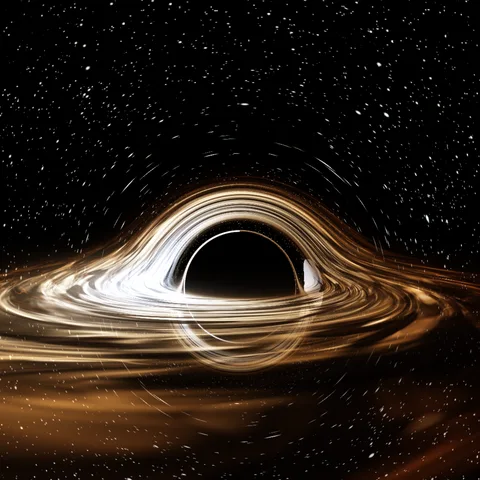
Cygnus X-1 is the first black hole astronomers agreed was real: twenty-one Suns crushed into a ball 125 km across, about 7,200 light-years away. What would you see if you fell in? The sky is no guess — light's path near a black hole can be worked out exactly.
- Where
- In Cygnus, the Swan, near the star Eta Cygni
- Distance
- About 7,200 light-years
- Mass
- About 21 Suns
- Event horizon
- About 125 km across
- Its companion
- A blue supergiant, HDE 226868, circling it every 5.6 days
What you would see
Far out, the black hole is a dark disc ringed by the bright, bent image of everything behind it. As you fall, the sky ahead crowds forward and brightens around the dark, while the sky behind you dims and reddens. At the photon sphere, one and a half times the horizon's size, light itself can circle the hole.
The event horizon has no wall and no mark — but past it, nothing gets back out. Inside, the dark ahead spreads until it fills half the sky.
Torn apart
Long before the horizon, the pull on your feet would outrun the pull on your head by a hundred times Earth's gravity: a person would be stretched apart — spaghettified — well outside a black hole this small. Past that point the simulation shows what a camera would see.
From the horizon to the centre takes about 0.14 thousandths of a second by the faller's own clock.
A star swallowed
A star that strays too near a black hole meets the same pull: it is torn into a long stream, part flung away and part wound in, flaring as it lands. Cygnus X-1 is not doing this — its companion is safely in orbit, feeding it gas — so Exo-View's version is a what-if, played at its real place.
A bet on it
In 1974 Stephen Hawking bet Kip Thorne that Cygnus X-1 was not a black hole — insurance, he said, in case his work on them came to nothing. By 1990 the evidence was in, and Hawking conceded.
Fall into Cygnus X-1Watch a star swallowed