Solar system · Mercury
Where is Mercury right now?
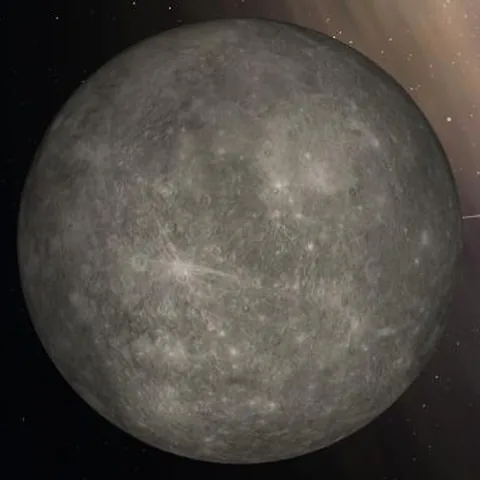
Mercury is the smallest planet and the nearest to the Sun, going round it in just 88 days, faster than any other. It is hard to see, always close to the Sun in the sky, but Exo-View shows where it is at this moment and lets you fly out to it.
- Orbit
- 88 days
- Distance from the Sun
- 0.39 AU on average, from 0.31 to 0.47
- Width
- 4,879 km, a little over a third of the Earth's
- Spin
- Once in 58.6 days
- Day
- From one sunrise to the next takes 176 Earth days, two of its years
- Temperature
- About 430 °C by day, about −180 °C by night
- Moons
- None
A day longer than a year
Mercury spins three times for every two trips round the Sun. Together with its fast orbit, that makes the Sun take 176 Earth days to get from one noon to the next, twice its year. With almost no air to hold the heat, the sunlit side bakes and the night side freezes.
Ice at the poles
Although it is the nearest planet to the Sun, Mercury has water ice. In craters at its poles, where the Sun never shines, it stays cold enough for ice to last for billions of years, which NASA's MESSENGER spacecraft, in orbit round the planet from 2011 to 2015, confirmed. The planet is also strangely dense, with a huge iron core, wider than our Moon, taking up most of its inside. A European–Japanese craft, BepiColombo, is on its way to study it further.
Seeing it
Mercury is never more than about 28° from the Sun, so it can be seen only low in the west just after sunset or low in the east just before sunrise, for a few weeks at a time, as a bright, steady point. It is easier to find in the spring evenings or the autumn mornings in the north, when the angle of the ecliptic to the horizon is steepest.
In Exo-View
The button below flies from the Sun to Mercury, drawn from its maps. Run the clock forward to see how fast it laps the Sun, and how it appears first on one side of the Earth's sky, then the other.
Fly to MercurySee every planetMore from the sky
- Space simulations in 3D
- The total solar eclipse of 2 August 2027
- T Coronae Borealis, the Blaze Star
- When Betelgeuse explodes
- Meteor showers, through the year
- Falling into a black hole
- Where is the International Space Station right now?
- Every working satellite in orbit
- Where are the planets right now?
- A 3D map of the Milky Way
- Where is Mars right now?
- Where is Jupiter right now?
- Where is Saturn right now?
- The Moon in 3D: where it is and how it moves
- Proxima Centauri: the nearest star to the Sun
- TRAPPIST-1: seven Earth-sized planets round one small star
- Tau Ceti: the nearest single star like the Sun
- Barnard's Star: the fastest-moving star in the sky
- The Orion Nebula: where stars are born
- The Crab Nebula: what is left of a star that exploded in 1054
- The Eagle Nebula and the Pillars of Creation
- The Helix Nebula: what will happen to the Sun
- Sagittarius A*: the black hole at the centre of the Milky Way
- Cygnus X-1: the first black hole anyone was sure of
- Gaia BH1: the nearest known black hole
- Sirius: the brightest star in the night sky
- Where is the James Webb Space Telescope right now?
- Where is the Hubble Space Telescope right now?
- Parker Solar Probe: the closest anyone has been to the Sun
- Where is Venus right now?
- Where is Uranus right now?
- Where is Neptune right now?
- Europa: a moon with an ocean under its ice
- Titan: the moon with lakes and weather
- Arcturus: the brightest star of the northern sky
- Teegarden's Star: a tiny star with Earth-mass planets
- The Horsehead Nebula: a cloud shaped like a horse
- The Carina Nebula: a star nursery with a star about to explode
- Gaia BH3: the heaviest black hole of its kind in the Milky Way
- Where is the Juno spacecraft right now?