Solar system · Neptune
Where is Neptune right now?
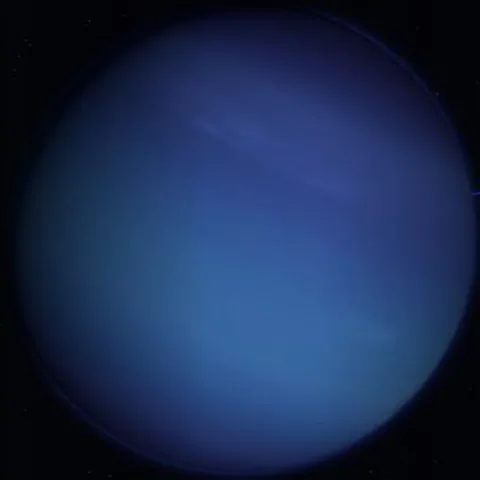
Neptune is the farthest planet from the Sun, 30 times the Earth's distance, and takes 165 years to go round once. It is a deep blue ice giant with the fastest winds in the solar system, and it was found not by looking but by working out where it must be. Exo-View puts it where it is at this moment.
- Orbit
- 164.8 years
- Distance from the Sun
- 30.1 AU on average, about 4.5 billion km
- Width
- 49,244 km, nearly four Earths
- Day
- About 16 hours
- Winds
- Up to about 2,100 km/h, faster than sound at its cold temperatures
- Temperature
- About −214 °C
- Moons
- Sixteen known; the largest is Triton
Found with a pencil
By the 1840s Uranus was not following the orbit that Newton's laws predicted, and astronomers suspected that the pull of another, unseen planet was tugging it. Urbain Le Verrier in France and John Couch Adams in England each worked out where it should be. On 23 September 1846 Johann Galle at the Berlin Observatory looked where Le Verrier had pointed and found Neptune within a degree of the spot. It was seen by a telescope, but found by mathematics.
A year of 165 Earth years
Neptune completed its first orbit since its discovery in July 2011. It is too faint to see with the naked eye and shows in a small telescope as a tiny blue disc. Its colour comes from methane in its air, with another ingredient no one has identified. Despite its distance from the Sun, it gives off more heat than it receives, and that heat drives winds that tear along at up to about 2,100 km/h.
Triton, the captured moon
Triton, Neptune's large moon, goes round it backwards, against the planet's spin, which is a sign that it did not form there: it is probably a dwarf planet from the Kuiper Belt that Neptune captured. Triton has geysers of nitrogen, and it is slowly spiralling in towards Neptune. Voyager 2, in August 1989, is the only craft that has visited.
In Exo-View
The button below flies from the Sun to Neptune. Run the clock forward and the planet barely moves, which is the point: its year is 165 of ours.
Fly to NeptuneSee every planetMore from the sky
- Space simulations in 3D
- The total solar eclipse of 2 August 2027
- T Coronae Borealis, the Blaze Star
- When Betelgeuse explodes
- Meteor showers, through the year
- Falling into a black hole
- Where is the International Space Station right now?
- Every working satellite in orbit
- Where are the planets right now?
- A 3D map of the Milky Way
- Where is Mars right now?
- Where is Jupiter right now?
- Where is Saturn right now?
- The Moon in 3D: where it is and how it moves
- Proxima Centauri: the nearest star to the Sun
- TRAPPIST-1: seven Earth-sized planets round one small star
- Tau Ceti: the nearest single star like the Sun
- Barnard's Star: the fastest-moving star in the sky
- The Orion Nebula: where stars are born
- The Crab Nebula: what is left of a star that exploded in 1054
- The Eagle Nebula and the Pillars of Creation
- The Helix Nebula: what will happen to the Sun
- Sagittarius A*: the black hole at the centre of the Milky Way
- Cygnus X-1: the first black hole anyone was sure of
- Gaia BH1: the nearest known black hole
- Sirius: the brightest star in the night sky
- Where is the James Webb Space Telescope right now?
- Where is the Hubble Space Telescope right now?
- Parker Solar Probe: the closest anyone has been to the Sun
- Where is Venus right now?
- Where is Mercury right now?
- Where is Uranus right now?
- Europa: a moon with an ocean under its ice
- Titan: the moon with lakes and weather
- Arcturus: the brightest star of the northern sky
- Teegarden's Star: a tiny star with Earth-mass planets
- The Horsehead Nebula: a cloud shaped like a horse
- The Carina Nebula: a star nursery with a star about to explode
- Gaia BH3: the heaviest black hole of its kind in the Milky Way
- Where is the Juno spacecraft right now?