Nebulae · star-forming
The Orion Nebula: where stars are born
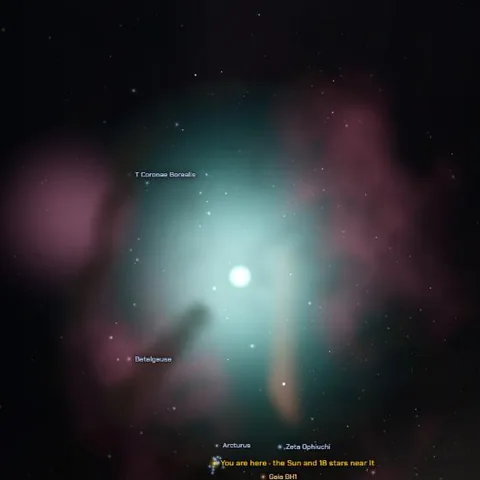
The Orion Nebula is the nearest great nursery of stars, 1,344 light-years away, and you can see it with no telescope at all: the fuzzy middle 'star' of the three in the sword that hangs below Orion's belt. It is a cloud of gas 24 light-years across, lit from inside by four newborn stars, and Exo-View lets you fly into it.
- Distance
- 1,344 light-years
- Width
- About 24 light-years
- Kind
- Emission nebula: gas glowing with the light of stars inside it
- Mass
- About 2,000 Suns of gas and dust
- Light source
- The Trapezium, four hot young stars at its heart
- Seen from
- The naked eye, as a hazy patch, on winter evenings in the north
How a nebula makes stars
A cloud of gas and dust, mostly hydrogen, collapses under its own weight into dense knots, and each knot grows hot enough at its centre to ignite and become a star. The four stars of the Trapezium formed in the last few million years, and their ultraviolet light makes the surrounding hydrogen glow pink. The stars are so young, and still so deep in dust, that many of the youngest were only revealed by infrared telescopes.
Planets in the making
The Hubble Space Telescope found many young stars in the nebula each wrapped in a disc of gas and dust, the same stuff our own planets formed from, some of them being slowly eroded by the glare of the Trapezium. These 'proplyds' are a view of what the Sun's own surroundings looked like some 4.6 billion years ago.
Finding it
Look for Orion's Belt, the line of three bright stars, and below it a short, fainter line of stars running down: Orion's sword. The middle 'star' of the sword looks slightly fuzzy, and binoculars show a pale cloud round it. It is best on winter evenings in the northern hemisphere, from December to February. Nearby on the sky, in the same great cloud, are the Flame and Horsehead Nebulae.
In Exo-View
The key below flies from the Sun to the nebula. Seen from here it is a smudge about two Moons wide; flown to, it fills the screen. Its drawn shape is made from photographs of the nebula, so it is an artist's impression, and the plate says so.
Fly into the Orion NebulaWatch Betelgeuse explodeMore from the sky
- Space simulations in 3D
- The total solar eclipse of 2 August 2027
- T Coronae Borealis, the Blaze Star
- When Betelgeuse explodes
- Meteor showers, through the year
- Falling into a black hole
- Where is the International Space Station right now?
- Every working satellite in orbit
- Where are the planets right now?
- A 3D map of the Milky Way
- Where is Mars right now?
- Where is Jupiter right now?
- Where is Saturn right now?
- The Moon in 3D: where it is and how it moves
- Proxima Centauri: the nearest star to the Sun
- TRAPPIST-1: seven Earth-sized planets round one small star
- Tau Ceti: the nearest single star like the Sun
- Barnard's Star: the fastest-moving star in the sky
- The Crab Nebula: what is left of a star that exploded in 1054
- The Eagle Nebula and the Pillars of Creation
- The Helix Nebula: what will happen to the Sun
- Sagittarius A*: the black hole at the centre of the Milky Way
- Cygnus X-1: the first black hole anyone was sure of
- Gaia BH1: the nearest known black hole
- Sirius: the brightest star in the night sky
- Where is the James Webb Space Telescope right now?
- Where is the Hubble Space Telescope right now?
- Parker Solar Probe: the closest anyone has been to the Sun
- Where is Venus right now?
- Where is Mercury right now?
- Where is Uranus right now?
- Where is Neptune right now?
- Europa: a moon with an ocean under its ice
- Titan: the moon with lakes and weather
- Arcturus: the brightest star of the northern sky
- Teegarden's Star: a tiny star with Earth-mass planets
- The Horsehead Nebula: a cloud shaped like a horse
- The Carina Nebula: a star nursery with a star about to explode
- Gaia BH3: the heaviest black hole of its kind in the Milky Way
- Where is the Juno spacecraft right now?