Nebulae · star-forming
The Carina Nebula: a star nursery with a star about to explode
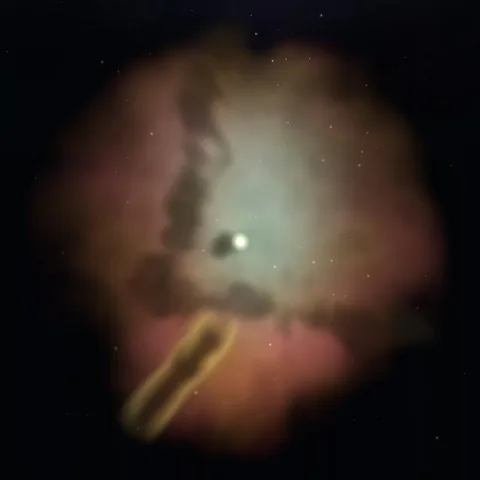
The Carina Nebula, 8,500 light-years away in the southern sky, is one of the biggest and brightest star-forming clouds in our galaxy, about 460 light-years across, far bigger than the Orion Nebula. Inside it is Eta Carinae, a star a hundred times as heavy as the Sun that nearly tore itself apart in 1843. Exo-View flies you there.
- Distance
- About 8,500 light-years
- Width
- About 460 light-years
- Kind
- Emission nebula and star-forming cloud
- Catalogue number
- NGC 3372
- Notable star
- Eta Carinae, about 100 Suns in mass
- Seen in
- The constellation Carina, from the southern hemisphere, to the naked eye
A star that nearly blew apart
Eta Carinae was an ordinary star of about fourth magnitude until, in the 1840s, it erupted, becoming for a time the second brightest star in the sky, and threw off two giant lobes of gas that still glow. The star survived, but it is unstable, and astronomers expect it to explode as a supernova, perhaps in the next several hundred thousand years, or sooner; it is far enough away that the explosion would pose no danger to us.
The cliffs
The nebula is a huge wall of gas and dust sculpted by the winds and light of hundreds of massive young stars. In 2022 the James Webb Space Telescope took a picture of its edge, nicknamed the Cosmic Cliffs, showing glittering new stars appearing from behind dust that looks like mountains. It was found in the 1750s by Nicolas-Louis de Lacaille, working from South Africa.
In Exo-View
The button below flies from the Sun to the Carina Nebula. Its shape is made from photographs, so it is an artist's impression, and the plate says so.
Fly to the Carina NebulaSee the Eagle NebulaMore from the sky
- Space simulations in 3D
- The total solar eclipse of 2 August 2027
- T Coronae Borealis, the Blaze Star
- When Betelgeuse explodes
- Meteor showers, through the year
- Falling into a black hole
- Where is the International Space Station right now?
- Every working satellite in orbit
- Where are the planets right now?
- A 3D map of the Milky Way
- Where is Mars right now?
- Where is Jupiter right now?
- Where is Saturn right now?
- The Moon in 3D: where it is and how it moves
- Proxima Centauri: the nearest star to the Sun
- TRAPPIST-1: seven Earth-sized planets round one small star
- Tau Ceti: the nearest single star like the Sun
- Barnard's Star: the fastest-moving star in the sky
- The Orion Nebula: where stars are born
- The Crab Nebula: what is left of a star that exploded in 1054
- The Eagle Nebula and the Pillars of Creation
- The Helix Nebula: what will happen to the Sun
- Sagittarius A*: the black hole at the centre of the Milky Way
- Cygnus X-1: the first black hole anyone was sure of
- Gaia BH1: the nearest known black hole
- Sirius: the brightest star in the night sky
- Where is the James Webb Space Telescope right now?
- Where is the Hubble Space Telescope right now?
- Parker Solar Probe: the closest anyone has been to the Sun
- Where is Venus right now?
- Where is Mercury right now?
- Where is Uranus right now?
- Where is Neptune right now?
- Europa: a moon with an ocean under its ice
- Titan: the moon with lakes and weather
- Arcturus: the brightest star of the northern sky
- Teegarden's Star: a tiny star with Earth-mass planets
- The Horsehead Nebula: a cloud shaped like a horse
- Gaia BH3: the heaviest black hole of its kind in the Milky Way
- Where is the Juno spacecraft right now?