Space station · where it is now
Where is the International Space Station right now?
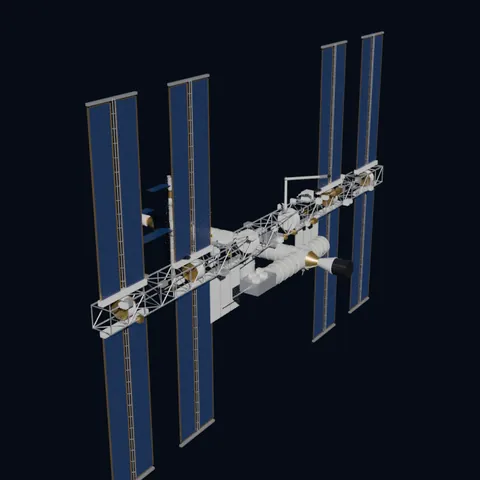
The International Space Station circles the Earth about every 93 minutes, some 420 km up, at close to 27,600 km/h — so its crew see the Sun rise about every 90 minutes. Exo-View shows where it is over the ground at this moment, the path of one orbit round it, and a plate of its figures.
- Orbit
- About 93 minutes: 15.5 times a day
- Height
- About 420 km, a few kilometres up or down over an orbit and between the boosts that lift it
- Speed
- About 27,600 km/h, or 7.7 km a second
- Tilt of its orbit
- 51.6° to the equator: it never passes over a place farther north or south than that
- Size
- About 109 m across
- Built by
- Five space agencies — NASA, Roscosmos, ESA, JAXA and CSA — with fifteen countries taking part
- Lived in
- Without a break since 2 November 2000
Where it is, and how Exo-View knows
The station's place is worked out in your browser from its published orbital elements (NORAD's two-line set), so the page asks no one where it is. The elements are good to a few kilometres for about two weeks after they are taken, and the plate marks the place as approximate once they are older. The figures are for interest, not for navigation.
Seeing it from the ground
On the right passes the station is easy to see with the naked eye: a bright, steady white light, brighter than almost any star and never blinking, that crosses the sky in a few minutes. It needs the sky to be dark where you stand and the station still in sunlight, so look shortly after dusk or before dawn. Exo-View uses that rule: a pass counts as visible when the station is in sunlight and the Sun is more than 6° below the horizon.
Choose a home country on the station's plate and it shows the next pass over that country's capital, in your own time zone: when, how high the station climbs, and whether you could see it by eye.
Why it is over somewhere different each time
The station's orbit stays fixed in space while the Earth turns beneath it, so each orbit it crosses the equator about 23° of longitude farther west than the last. Its path swings between 51.6° north and 51.6° south, which takes it over most of the inhabited world — but never directly over Iceland, northern Scandinavia or the far north of Canada and Russia, where it can only be seen low in the sky.
In Exo-View
The key below switches the ISS layer on and flies the camera in to the station. Circle a model of it with the horizon level, open its plate for its height, speed, sunrises and who built it, and press “View from the station” to look down at the Earth from its window. The model is drawn larger than life so that you can see it, and the plate says so.
Find the ISS now