Nebulae · planetary
The Helix Nebula: what will happen to the Sun
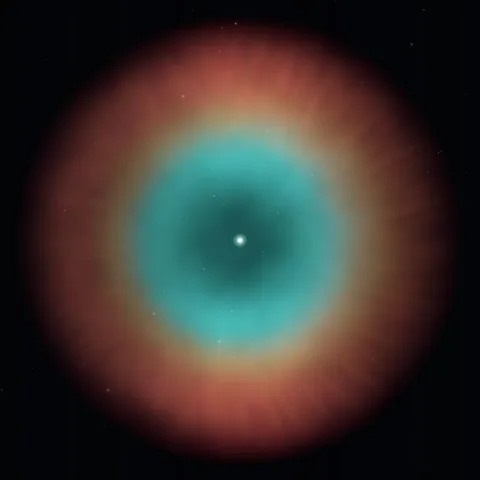
The Helix Nebula is the shell of gas a dying star shed about 10,000 years ago, 655 light-years away in the constellation Aquarius, with the hot core of the star, a white dwarf, shining at its centre. The Sun will do the same in about five billion years, so the Helix is a picture of our own future.
- Distance
- About 655 light-years
- Width
- About 2.9 light-years, over half the Moon's width on our sky
- Kind
- Planetary nebula, nothing to do with planets
- Catalogue number
- NGC 7293
- Age
- About 10,000 years
- Centre
- A white dwarf, the star's bare core, at about 100,000 K
Why 'planetary'?
Nothing in it is a planet. William Herschel called such shells 'planetary nebulae' in the 18th century because through his telescope they were round and greenish, like the disc of Uranus. They are the final act of stars from about 0.8 to 8 times the Sun's mass.
How a Sun-like star dies
When a star like the Sun runs out of hydrogen to burn at its core it swells into a red giant and, over a few hundred thousand years, throws off its outer layers. What is left is the core, a white dwarf about the size of the Earth, white-hot, and so hot that its ultraviolet light makes the surrounding gas glow. A shell like this lasts about 10,000 to 20,000 years before it thins away into space.
The Sun is due to swell into a red giant in about five billion years. It will swallow Mercury and Venus, and perhaps the Earth, and then leave a nebula like this one round a white dwarf.
Thousands of comet-shaped knots
The Helix is close enough that telescopes see details in it: about 20,000 small knots of gas, each with a tail pointing away from the star like a comet, each about the size of our solar system. Its nickname, the Eye of God, comes from how it looks in photographs: an eye with a bright blue-green iris and a white pupil.
In Exo-View
The key below flies from the Sun to the Helix Nebula, a ring of orange and red round a blue-green centre. The shape is drawn from the nebula's photographs, an artist's impression, and the plate says so.
Fly to the Helix NebulaFly to the SunMore from the sky
- Space simulations in 3D
- The total solar eclipse of 2 August 2027
- T Coronae Borealis, the Blaze Star
- When Betelgeuse explodes
- Meteor showers, through the year
- Falling into a black hole
- Where is the International Space Station right now?
- Every working satellite in orbit
- Where are the planets right now?
- A 3D map of the Milky Way
- Where is Mars right now?
- Where is Jupiter right now?
- Where is Saturn right now?
- The Moon in 3D: where it is and how it moves
- Proxima Centauri: the nearest star to the Sun
- TRAPPIST-1: seven Earth-sized planets round one small star
- Tau Ceti: the nearest single star like the Sun
- Barnard's Star: the fastest-moving star in the sky
- The Orion Nebula: where stars are born
- The Crab Nebula: what is left of a star that exploded in 1054
- The Eagle Nebula and the Pillars of Creation
- Sagittarius A*: the black hole at the centre of the Milky Way
- Cygnus X-1: the first black hole anyone was sure of
- Gaia BH1: the nearest known black hole
- Sirius: the brightest star in the night sky
- Where is the James Webb Space Telescope right now?
- Where is the Hubble Space Telescope right now?
- Parker Solar Probe: the closest anyone has been to the Sun
- Where is Venus right now?
- Where is Mercury right now?
- Where is Uranus right now?
- Where is Neptune right now?
- Europa: a moon with an ocean under its ice
- Titan: the moon with lakes and weather
- Arcturus: the brightest star of the northern sky
- Teegarden's Star: a tiny star with Earth-mass planets
- The Horsehead Nebula: a cloud shaped like a horse
- The Carina Nebula: a star nursery with a star about to explode
- Gaia BH3: the heaviest black hole of its kind in the Milky Way
- Where is the Juno spacecraft right now?